The college admissions scandal brings attention to a pervasive issue - that of parents' inability to understand the importance of letting go. This article looks at six detrimental parenting patterns and addressing them in social work practice.
from The New Social Worker Online — the professional social work careers magazine http://bit.ly/2URux8H
Tuesday, April 23, 2019

Marketing Tips to Glean Graduates

Graduation 2019 is around the corner - start booking trials and Graduation Day appointments now. Graduation season begins in May and runs through the month of June. Providing special graduation day services provides an opportunity to introduce your salon to students of all ages - this is especially relevant to salons located in college-towns. This walk across the stage serves up a huge opportunity to offer ‘celebrate the graduate packages can bring extra business to your beauty business the last weeks of spring.
Junior high, high school, college and university graduates across the country are spending money on men's and women's hair, makeup, brow shaping, facials, sunless tanning, manicures and pedicures. Be sure to build the Graduation season into your marketing calendar every year. Here are a few ways:
1) Offer Special Graduation Promotion Packages.
Creating affordable packages geared toward students generates new business, use graduation season as a chance to connect with students directly. Put together packages at 3 different price points and secure appointments with a 50% deposit (non-refundable).
2) Referrals Rock.
Talk up your graduation services and promotions to current clients starting several weeks in advance. Word of mouth is one of the best ways to market your business. Try a friend referral offer for graduation services. For example: Schedule graduation services for yourself and a friend, receive Lash Application for free.
3) Offer special splurges.
If there’s ever a time that a student to splurge for a fancy hair clip, earrings or lip gloss, it’s for graduation. Even if you don’t typically stock these kinds of items, investing in some beauty accessories and displaying attractively in key retail area/s boosts the bottom line every time.
4) Check the dates for local graduations.
Call your local junior highs, high schools, colleges and universities to ask graduation ceremony dates. These dates will change every year, so in order to plan and staff accordingly make sure these dates are highlighted in your calendar.
5) Socialize.
Target graduates by posting "graduate-related" content May - June. Share inspirational quotes, congratulations and graduation planning tips. Facebook ads are a great place to start advertising special graduate offers and services.
6) Graduation Packages Email.
When the time comes to plan graduation day beauty services make sure your salon is “top of mind” of regional graduates. Send an e-mail campaign to promote your graduate packages. For easy booking offer simple price points with memorable package names such as "Top of the Class", "Follow Your Dreams", "Valedictorian", or "One Smart Cookie". Get creative!
7) Gift Cards for Grads.
Gifts for high school and college students should be highlighted at this time as well. Gift cards are the perfect gift, remind gift givers by displaying prominently with graduation cards.
from Beauty Business Blog http://bit.ly/2PqfCfv
Monday, April 22, 2019
Clinical Intersections: Grief, Trauma, and Complex Trauma - 5 Questions & Answers for Social Workers
The more we use the word trauma to describe the sequelae from psychological stressors, the more we lose the nuance around ways trauma can show up and make itself known. These questions and answers clarify differences between grief, trauma, & C-PTSD.
from The New Social Worker Online — the professional social work careers magazine http://bit.ly/2L5LebE
from The New Social Worker Online — the professional social work careers magazine http://bit.ly/2L5LebE
Saturday, April 20, 2019
Top Five Ways to Spend Your Dry Day in Raja Ampat
Most divers know of Raja Ampat, one of the world’s best scuba-diving destinations. This Indonesian archipelago is also known as the Four Kings. Justifiably, it attracts scuba enthusiasts from around the world who dream of a colorful and abundant underwater wonderland. Raja Ampat’s spectacular marine world gets a lot of attention from journalists, photographers, and scuba fans, but Raja offers equally stunning topside attractions. If you’re planning a land-based trip here for your next scuba adventure, stay near Waigeo to enjoy some of these unique topside attractions.
Pianemo
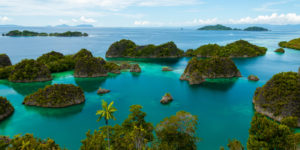
Pianemo offers iconic Raja scenery.
You may have seen iconic photos of a cluster of island mounds floating in an ocean of turquoise. Photos of Pianemo represent Raja Ampat in almost every media outlet, travel magazine, and marketing tool. And understandably so, as the view from the top of Pianemo leaves most people speechless.
If you’re staying in any of the islands around Waigeo, you can hire a speedboat to take you to Pianemo. From the main town of Waisai in Waigeo, the trip can take about 1.5 hours one way. Even though Pianemo has become a bit touristy, the view makes the trip worthwhile.
Arborek village

Local village in Raja (Credit: Mo Ohashi)
As part of the Indonesia government’s tourist program, the tiny island of Arborek and its native Papuan habitants offer performances with traditional dance and music to introduce visitors to a unique cultural experience. The white-sand beaches surrounding the island, the local village life, and stunning reefs just offshore make this enchanting island a must-visit if you are staying in Waigeo. Arborek village also offers simple accommodations, souvenir shops, small stands for snacks and drinks and even a dive center. Conveniently located en route to the famous Pianemo, Arborek makes for a great stopover.
Bird watching

Wilson’s bird of paradise competes to attract a female by dancing on the forest floor.
Raja Ampat is home to endemic Birds of Paradise (Cendarawasih) which, according to National Geographic, are “some of the world’s most dramatic and attractive birds.” Aside from the colorful and vibrant colors, the Cendarawasih birds are also renowned for being fabulous dancers and singers. Of the 41 Cenderawasih species in Indonesia, 37 live in the Papua region alone. Two of these species in particular — Wilson’s Bird of Paradise and Paradise Red — are endemic to Raja Ampat. They most commonly live in the jungles of Batanta and Waigeo.
Since these rare birds appear mostly in the early mornings from around 5:30 to 6:30 am, you can even squeeze in a birdwatching tour before you dive. Many local guides will be happy to show you around.
Jungle exploration

Kalibiru River lies deep in the jungle. (credit: Mo Ohashi)
Much of Raja remains relatively untouched and unexplored rainforest, abundant with fascinating wildlife and plant species. In the thick jungle of Waigeo, you can find Kalibiru, the highlight of my last trip to Raja Ampat. This crystal-clear, turquoise freshwater river runs through the lush, green forest. Even more spectacularly, you can watch this river originating from the ground, gushing out between the rocks and dirt at your feet.
Island hopping

Island hopping in Raja means visiting paradises like this. (credit: Mo Ohashi)
Aside from the four main islands that make up Raja Ampat, smaller islands are also dot the region. Most have beautiful lagoons, white-sand beaches, and shallow reefs. Often, you can simply jump in with your mask and snorkel and encounter reef sharks, turtles, and even dugongs if you’re lucky.
Hire a speedboat for the day and explore some of the remote, uninhabited islands, with some of the planet’s most stunning shades of blue. No matter how you choose to spend your topside time in Raja Ampat, it will not disappoint you.
Mo Ohashi is a Bali-based scuba instructor whose current passions include coconut ice cream, rescuing street dogs, and sharing her travel tips and resources on Travelust 101. You can follow her adventures on Instagram and contact her for tips on guides for Kalibiru.
The post Top Five Ways to Spend Your Dry Day in Raja Ampat appeared first on Scuba Diver Life.
from Scuba Diver Life http://bit.ly/2KUsXOz
Thursday, April 18, 2019
Keep On Walking
Keep On Walking - a poem by social worker Amy Stage.
from The New Social Worker Online — the professional social work careers magazine http://bit.ly/2GfThwU
from The New Social Worker Online — the professional social work careers magazine http://bit.ly/2GfThwU
Preserving America’s Underwater Battlefield: E.M. Clark
From January to the end of August 1942, German U-boats attacked more than 285 vessels in North American waters. Just off coastal North Carolina, the remnants of many of these ships are scattered on the ocean floor. The remains of this little-known battlefield serve as the final resting place for 90 ships and nearly 1,700 men lost during the Battle of the Atlantic. Over the course of the battle, eight Allied convoy vessels, 78 merchant freighters and tankers and four German U-boats sank off North Carolina’s coast. Each shipwreck tells a unique story; today we visit the E.M. Clark.
E.M. Clark sinks
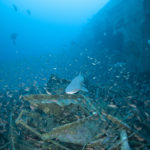
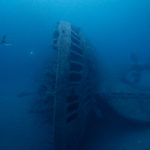
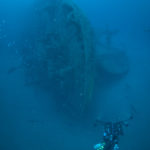

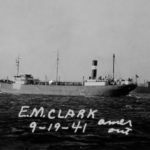
During World War II, E.M. Clark was part of a larger transportation network that carried petroleum products to support the Allied war effort both at home and abroad. Standard Oil Company of New Jersey owned the ship, which made 41 voyages from 1939 to 1941, carrying over 4 million barrels of petroleum products. In 1942, E.M. Clark completed two trips, but its third trip for the year would it be its last.
On March 11, 1942, E.M. Clark left Baton Rouge, Louisiana carrying 118,000 barrels of heating oil destined for New York. As darkness fell the evening of March 17, the ship encountered rough seas and lightning as it approached the Diamond Shoals Light Buoy. Around 1:00 am, U-124, lurking just southwest of the buoy, spotted E.M. Clark traveling alone. Using the squally weather conditions, U-124 moved close to E.M. Clark and fired one torpedo that tore into the tanker’s port side four feet below the waterline.
The exploding torpedo buckled the deck and brought down the foremast and radio equipment. While the crew attempted to rig an emergency radio distress signal, another torpedo ripped through the stricken vessel at the bow. The ship was fatally wounded and sank in just 10 minutes.
By the time E.M. Clark was bow down in the water, the sea was covered in oil, making the men in the lifeboats sick from the fumes. U-124 surfaced and for about an hour and a half circled E.M. Clark and its lifeboats. The submarine was last seen at 3:00 a.m. heading northwest looking for another target. Of the 41-man crew, 40 survived and were rescued. The USS Dickerson rescued 14 survivors and the Venezuelan tanker Catatumbo rescued the other 26.
Diving the E.M. Clark
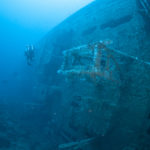


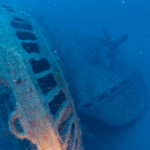
Resting on its port side in about 240 feet (73 m) of water, E.M. Clark is completely intact from bow to stern. It is one of the best representations of a World War II merchant ship off the North Carolina coast. Although the depth of the shipwreck will prohibit all but the most experienced technical divers from exploring the site, E.M. Clark nonetheless offers the technical diver a unique dive experience on a very well-preserved shipwreck.
“Visibility at the wreck site is stunning,” says Tane Casserley, Monitor National Marine Sanctuary’s research coordinator and NOAA diver.
“When you start at the bow, the prevailing current helps you to glide along the wreck, allowing you to truly experience the wreck and all the marine life. As you move toward the stern, the wreck begins to disappear behind you. Then you come to the fantail, which is beautiful. To me, the architecture of that section looks like the Statue of Liberty’s crown and offers a vivid reminder of why World War II was fought and why we work so hard to protect these shipwrecks.”
The site of E.M. Clark measures 499 feet long (152 m) and the site’s main feature is the steel hull, which lies mostly intact on its port side. The hull’s exterior steel plates are in excellent condition with only small areas of deterioration. The wreck’s highest point is the starboard side main deck, which sits at least 50 feet (15 m) off the seafloor.
The bow’s starboard anchor is in place and visible in the hawse pipe. The port-side anchor is buried in the sand under the vessel. Both anchor chains run up through the hawse pipes to the deck, where they wrap over the windlass and continue down into the chain locker. The deck plating in the bow has deteriorated, exposing beams and cross bracing. Additionally, there are large holes in the top of the main deck that allow access to interior compartments.
Moving aft, the bridge structure has fallen to the seafloor. Only the outline of where the bridge met the deck indicates where the superstructure once sat. The bridge and all of the associated components, including stateroom and pilothouse materials and portholes, are scattered on the seafloor in a large pile. The main deck planking in this area has also eroded away, exposing the interior of the empty cargo tanks.
All three of E.M. Clark’s masts have fallen over and lie on the seafloor. The skylight that sat above the engine room is gone, resulting in a large opening 20 feet (6 m) wide. The large, single rudder and two propellers and shafts are intact. The entire starboard propeller remains visible, but only half of the port side propeller protrudes from the sand.
Marine life on the E.M. Clark
Lying near the western margin of the Gulf Stream, the warm water and the remains of E.M. Clark make the perfect home for an ecosystem teeming with life. The artificial reef supports encrusting invertebrates and a wide variety of fish and sharks. This, coupled with the site’s historic significance, make this a popular spot for technical divers looking for an intact World War II shipwreck.
As with other World War II shipwrecks, E.M. Clark is a war grave. Visitors should not disturb the site, leaving the wreck and its artifacts in place for future generations.
In July 2013, NOAA’s Office of National Marine Sanctuaries nominated E.M. Clark for listing on the National Register of Historic Places and it was accepted. To learn more about the E.M. Clark and other World War II shipwrecks off the North Carolina coast, click here.
An expanded sanctuary
In an effort to honor the service and sacrifice of those lost during the Battle of the Atlantic, NOAA in 2019 will release a draft proposal to expand the boundaries of Monitor National Marine Sanctuary to include a nationally significant collection of shipwrecks that currently have little or no legal protection. The expansion would also establish the largest area designated as a World War II battlefield anywhere in the world.
To learn more about the proposal, click here.
By Shannon Ricles, Monitor National Marine Sanctuary
The post Preserving America’s Underwater Battlefield: E.M. Clark appeared first on Scuba Diver Life.
from Scuba Diver Life http://bit.ly/2GmuGXz
Wednesday, April 17, 2019
Social Work, Inc.: How Benefit Corporations Grow Your Business With Social Responsibility
There are a number of reasons for social workers to consider incorporating as a benefit corporation. Benefit corporations must be committed to creating a public benefit in addition to generating a profit.
from The New Social Worker Online — the professional social work careers magazine http://bit.ly/2InBWpm
from The New Social Worker Online — the professional social work careers magazine http://bit.ly/2InBWpm
Maximize Mother's Day

In North America Mother’s Day is one of the biggest “gift giving” holidays of the year. Salons and spas are perfect businesses to benefit from a Mother’s Day promotion that translates services and retail products into great Mother’s Day salon or spa packages. Remind consumers that gift cards, service packages and pampering retail products make memorable gifts for moms, grandmothers, aunts, wives and daughters.
Marketing studies tell us that Mother's Day spending peaks in the week between the 5th and the 12th of May so make sure to implement your Mother's Day campaign as soon as possible. Make this year’s Mother’s Day the most successful one yet, attract the right consumers to your salon for their gift-giving needs.
TIP #1 Cover All Budget Types
Divide up your service and product selections for all budgets, provide package options in different amounts to cover all budgets types.
TIP # 2 Think MEN
Remember that men purchase a significant portion of Mother’s Day gifts overall, put your Mother’s Day campaign in the windows in the form of posters to get walk-by traffic to walk-in. Market directly to men with a “stressed to the max wife” Mother’s Day hair or spa package.
TIP #3 Promote Everywhere
Promote your salon or spa Mother’s Day specials on all marketing channels including social media, website, and “in-store”.
1) Update website homepage slideshow to include image of Mother’s Day promotion
2) Post Mother’s Day promotion on all social media channels.
3) Create Mother’s Day promotional signage for windows and mirror talkers for individual stations.
4) Create scripts for staff to help them start the conversation about Mother’s Day behind the chair or at the point of purchase.
TIP #4 Gift Cards
Did you know that the most popular time for Mother's Day gift card sales is Mother's Day “eve”? Make sure it’s easy to purchase gift certificates in person and from your website. You should have both print and email delivery options available. Gift cards can be a big money making opportunity for salons if panicked gift givers can access your salon’s website and purchase a thoughtful gift for their loved one.
TIP #5 Mother’s Day Email
Send out an e-mail campaign announcing your Mother’s Day gift options. Remember that most sales for Mother’s Day will be at the last minute. Promote your salon or spa’s Mother’s Day packages or gift cards as perfect “last minute” gift options.
Run your campaign like this:
Email 1: May 1: Mother's Day Campaign Launch
Email 2: May 9: Only 3 Days left!
Email 3: May 12: Last 24 Hours Last Minute Gifts = Gift Cards
TIP #6 Pre-Made Mother's Day Campaigns
It's not too late to capitalize on Mother's Day in your salon with pre-made campaigns from BeautyMark Marketing. Learn more here


beauty business, beauty salon email marketing, mother's day marketing, mother's day marketing ideas, mother's day promotions, mother's day tips, salon email marketing, salon marketing ideas for mother's day, salon promotions for mother's day mother's day marketing, salon promotions for mother's day, mother's day business tips
from Beauty Business Blog http://bit.ly/2Xm3gYI
Dialogues on Gun Violence: The Role of Social Work Values and Principles
As we approach conversations on gun violence, we need to keep in mind social work values of integrity, respect, human relationships, and competence.
from The New Social Worker Online — the professional social work careers magazine http://bit.ly/2UIbsW7
from The New Social Worker Online — the professional social work careers magazine http://bit.ly/2UIbsW7
A Matter of Speaking: For Social Workers, How To Give a Presentation With Confidence, Humor, and Impact
Regardless of your social work practice area, professional presentation skills are a must. Yet, 75% of people are afraid of public speaking.
from The New Social Worker Online — the professional social work careers magazine http://bit.ly/2GkmqqS
from The New Social Worker Online — the professional social work careers magazine http://bit.ly/2GkmqqS
Say You’re a Social Worker
You hold a social work degree because you chose social work. Be proud of it and call yourself a social worker.
from The New Social Worker Online — the professional social work careers magazine http://bit.ly/2UIbUUj
from The New Social Worker Online — the professional social work careers magazine http://bit.ly/2UIbUUj
Assessing for PTSD in Terminally Ill Patients
Over the course of a lifetime, most people will experience at least one potentially traumatizing event. Social workers can take a multi-dimensional, ongoing approach to assessing for PTSD in terminally ill patients.
from The New Social Worker Online — the professional social work careers magazine http://bit.ly/2GwGkzh
from The New Social Worker Online — the professional social work careers magazine http://bit.ly/2GwGkzh
How To Train the Technology Monster We Cannot See
Is the technology monster sneaking into your life and draining your resources?
from The New Social Worker Online — the professional social work careers magazine http://bit.ly/2UIbTjd
from The New Social Worker Online — the professional social work careers magazine http://bit.ly/2UIbTjd
The Intersection of Autoimmune Disease and Social Work: An Effective Partnership for Health
There are 80 to 100 autoimmune diseases. As the prevalence of autoimmune disease rises, the number of patients who will seek the support of social workers will also increase.
from The New Social Worker Online — the professional social work careers magazine http://bit.ly/2GpVIxk
from The New Social Worker Online — the professional social work careers magazine http://bit.ly/2GpVIxk
Will I Have a Social Work Legacy?
I am not known for my writing, research, or speaking. I don’t have a program named after me. But over the years, as a social worker, I have interacted with hundreds, probably thousands, of young people.
from The New Social Worker Online — the professional social work careers magazine http://bit.ly/2UIbSf9
from The New Social Worker Online — the professional social work careers magazine http://bit.ly/2UIbSf9
Book Review: Dare to Lead
Book review of Dare to Lead by Brené Brown, reviewed by Lisa Eible.
from The New Social Worker Online — the professional social work careers magazine http://bit.ly/2GirWKF
from The New Social Worker Online — the professional social work careers magazine http://bit.ly/2GirWKF
Book Review: White Fragility
Book review of White Fragility by Robin Diangelo, reviewed by Lisa Eible.
from The New Social Worker Online — the professional social work careers magazine http://bit.ly/2UIbRb5
from The New Social Worker Online — the professional social work careers magazine http://bit.ly/2UIbRb5
Book Review: Older, Wiser, Shorter
Book review of Older, Wiser, Shorter by Jane Seskin, reviewed by Linda May Grobman.
from The New Social Worker Online — the professional social work careers magazine http://bit.ly/2UEK3oa
from The New Social Worker Online — the professional social work careers magazine http://bit.ly/2UEK3oa
Monday, April 15, 2019
Self-Care A-Z: 5 Harmful Self-Care Myths
Self-care is an ongoing struggle for social workers. These 5 myths make it harder, not easier.
from The New Social Worker Online — the professional social work careers magazine http://bit.ly/2X97G54
from The New Social Worker Online — the professional social work careers magazine http://bit.ly/2X97G54
Sunday, April 14, 2019
Choosing Regulators for Technical Diving
Buying recreational diving equipment is both daunting and exhilarating, and it’s no different when it comes to technical diving equipment. We took a look at the topic a little while ago, and here we’re going to delve a little deeper on how to go about choosing regulators for technical diving.
The basics
As a recreational diver, you may already own a set of regulators. Generally, this consists of a first stage, two second stages — one of which is mounted on a longer hose — a high-pressure hose for your submersible pressure gauge (SPG) and maybe a console plus one or two low-pressure inflator hoses for your BCD and your drysuit, if you’re diving in cold waters.
As an open-circuit technical diver, you will be carrying more than one tank, and consequently, you will be using more than one set of regulators. Each set has slightly different components depending on its purpose, but all will consist of a first stage, a second stage and a high-pressure hose with SPG — with one exception we’ll get to later in this post.
Which components are part of your individual regulators depends on when you are planning to use them on the dive. Roughly speaking, you can divide tech dives into three phases: the bottom part, travel to and from the bottom part, and the decompression phase.
Bottom or back-gas regulators
Bottom, or ‘back-gas,’ regulators attach to your twinset or your main sidemount tanks. While the term bottom gas is pretty self-explanatory, ‘back-gas’ refers to the fact that the twinset containing this gas is usually on your back.
Whether you are diving air, nitrox or trimix, these are the regulators that you will be using during the deepest phase of your dive, when your breathing gas is most dense and therefore hardest to breathe. That means you are looking for high-performance regulators that can deliver a lot of gas to allow you to breathe as easily as possible. Your choice of gas obviously influences breathing ease, but your regs have a role to play as well.
Regulator configuration

The author models twinset configuration on a dive. (Credit Heather Sutton)
If you are diving twinsets, you need a first stage each for your left and right tank, also called left and right post. While there are some variations, most tech divers will have a second stage with a 7-foot (2 m) hose on the right as well as their inflator hose leading to their wing. The long hose connects to the second stage that tech divers generally breathe from. The hose is longer to allow divers to share gas and exit a restriction while swimming behind each other.
The left tank typically holds a second stage on a short regulator hose with a ‘necklace’ made from bungee cord or surgical tubing, as well as a high-pressure hose and an SPG. There may also be another inflator hose here for a drysuit or the second bladder of the BCD if it has one. The necklace allows the diver to easily reach their second stage in case they need to donate their long hose.
Did you notice there is no SPG on the right post? When diving manifolded (connected) twinset tanks, the diver accesses gas from both tanks through one regulator as long as the manifold isolator valve is open. This means that as long as there is no equipment failure, one SPG is enough.
Sidemount setups
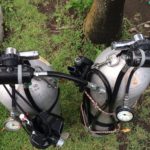
Sidemount setups can vary more as the configuration in general is more individual. One common option, however, is to rig the right tank with a first stage, a second stage on a long hose, and an SPG on a short high-pressure hose, usually about 6 inches (15 cm) long. There may also be an inflator hose for a drysuit or a second BCD bladder here.
On the left tank is a first stage with a second stage attached to a short hose and again equipped with a necklace. Often, there is an angled ‘elbow’ piece between the second stage and the hose, allowing divers to easily identify which tank they are breathing from. Additionally, there is a short high-pressure hose with an SPG and an inflator hose connecting to the sidemount harness and wing.
Many sidemount divers run their inflator across their body rather than over their shoulder. This means that suitable regulators often have a fifth low-pressure port at a right angle to the other ports. It’s also easier to streamline a sidemount setup by using first stages that have the capacity to swivel and therefore allow cleaner hose routing.
Some manufacturers have started offering dedicated twinset and sidemount regulator sets. This is a good way to purchase all the bits and pieces in one go. In the case of twinset regulators for example, they might have low-pressure ports pointing downward at an angle for better hose routing. Sidemount sets will have swiveling first stages with five low-pressure ports, one of which is at a right angle.
Deco regulators
Regulators for the decompression phase of the dive generally feature a first stage, second stage on a somewhat longer hose (octopus length) and an SPG on a short high-pressure hose.
Tech divers use these regulators with oxygen-rich nitrox mixes to help accelerate decompression and, therefore, the units must be suitable for use with oxygen. In practice, this means choosing a regulator that is made of a material with a high flash-point – titanium, for example. The regulator must also be cleaned for oxygen use, and any O-rings and greases used in the process must be oxygen-compatible. Not every regulator will be suitable fresh out of the factory, so it’s important to check on this when you are buying your deco regs.
As we generally use these regulators on shallower parts of the dive, we can use unbalanced first stages. However, this is still life-saving equipment, so the general recommendation to buy the highest quality possible while remaining practical.
Travel gas regulators
Trimix divers usually use ‘travel gas,’ a breathing gas that does not contain enough oxygen to sustain life on land. Their components will often resemble deco regulators, although they may not need to be oxygen-clean depending on the gases the diver uses.
If all that sounds daunting, consider this: you can usually rent equipment for your tech courses from the instructor or shop that is conducting the course. Most budding tech divers qualify initially to dive a twinset or sidemount tanks for the bottom part of the dive and one deco gas, so that’s ‘only’ three regulators. Additionally, you may be able to reconfigure some of the components you already own.
Last, but not least, consider where you will be diving. If you’re going to be in cold water, make sure your regs are suitable for that. If you will be spending a lot of time in remote areas, some brands will be easier to maintain than others due to the availability of spare parts and service technicians.
The first step when it comes to choosing regulators for technical diving is to speak to your instructor and other tech divers about what they use. Spend some time researching before going on that shopping spree. One thing is for sure — as your tech diving journey continues, your gear bag will only expand.
The post Choosing Regulators for Technical Diving appeared first on Scuba Diver Life.
from Scuba Diver Life http://bit.ly/2UGTGTu
Subscribe to:
Posts (Atom)