The post Ocean Stamps from Around the World appeared first on Scuba Diver Life.
from Scuba Diver Life https://ift.tt/2H4ptnf
The post Ocean Stamps from Around the World appeared first on Scuba Diver Life.

Good morning, my darlings! I am BACK…at least partly. We’ll see how it goes…you may hear from me more sporadically than usual while I sort out all of my health-related business.
I couldn’t let my health scare keep me from showing you the treasures I’m eyeing in Leslie Hindman’s upcoming April Important Jewelry sale! We’ve got some great entry-level priced beauties, some major league stunners, and even a Georgian Holy Grail piece that I think might start some fights.
Underwater hand signals are an integral part of any diver’s certification and a great way to communicate basic messages. But communicating while technical diving might require more than basic hand or even torch signals. Technical diving has some tools in its communications toolbox that open-water divers may find useful.
Watch technical divers signal each other underwater and it might seem like they speak a different language. Far from it, however. Techies have developed a system of hand signals that allows them to communicate fairly complex messages with as few precise signals as possible. The reason lies in the nature of technical diving: dives are generally more complex than recreational dives, both in terms of the dive objective and equipment. Divers must adhere to plans as strictly as possible to avoid low-on-gas situations and other problems. When something unforeseen happens, divers must quickly adjust.
One-handed communication is essential. The other hand is often occupied with a torch or a reel, to name only two pieces of equipment. Single-handed signaling starts with numbers to signal gas volumes and more. And the system is not complicated — after a few practice dives, many recreational divers prefer signaling this way. There are also simple signals for depth changes, usually consisting of an upward hand movement — ‘let’s go up’ — followed by the target depth. All team members then repeat this signal to avoid misunderstandings. After all, a diver signaling ‘okay’ might be confirming any number of things. Repeating the signal ensures that both divers meant the same thing.
There are hand signals for line laying, decompression time — or leftover no-decompression time as appropriate — entanglement and adding or subtracting dive time at specific depths. Many of these would benefit recreational divers too, as it’s common to near no-deco limits, for example, on repetitive dives.
Technical divers then add back-ups to their basic hand communications. In situations too complicated for simple hand signals, many technical divers carry wrist slates and waterproof notepads. Scribbling down a sentence or two can make an underwater conversation much easier. But even writing things down underwater is not always straightforward and it does take time. Therefore, many teams will use pre-planned phrases they can simply point to as needed.
This is also useful when an underwater dive team needs support from their surface team, including additional deco gas or a support diver. Having pre-written messages, which the surface team is already familiar with through briefings, can really speed things up in tricky situations.
But what happens when, quite literally, the lights go out? Most technical diving takes place in relatively dark waters. Most technical divers rely on lights for most, if not all, of their communications and to keep teams together. If light failure occurs or masks become unusable, technical divers revert to touch communications, basically transferring all of the one-handed signals mentioned above into short but precise messages converted either from the lead diver’s hand to the other diver’s arm or, in case the divers must travel single file, to their leg.
This method of communication is certainly complex and requires a lot of awareness and concentration. But tech divers also practice extensively during courses, as well as on dives. Touch communications can be useful in open-ocean diving, but they are essential for any serious overhead diving, including wreck and cave penetration. Anyone training for these courses will practice exercises and scenarios without a mask until feeling the way out becomes (almost) second nature.
Keep in mind that much of the success of these more complex communications depends on what happens before divers get in the water. unpracticed touch communications are just as dangerous as illegible hand writing, especially under the influence of narcosis and stress. In-depth briefings, regular skills practice and thorough de-briefs are the keys to successful communications on technical dives.
So how does communication while technical diving relate to recreational diving? On any dive, there is a chance of something unforeseen happening — current can change; divers can face equipment problems; buddy pairs can become separated. Clear communication, even for complex messages, will go a long way to help resolve any situation. Recreational divers can and should carry slates as well, not only for communication, but also to record what they may have seen. Clear, concise communication means a more enjoyable dive, whether technical or recreational.
The post Communicating While Technical Diving appeared first on Scuba Diver Life.
Just as on land, where the nocturnal world is quite different from the daytime one, so too does a new environment appear underwater after dark. Even your most regular dive spot becomes mysterious at night. But what makes a night dive so different from a daytime dive? Here are five great night dive experiences you can only have after the sun goes down.
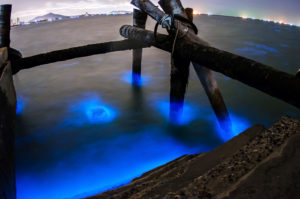
Bioluminescence is one of the ocean’s most magical night dive experiences. The phenomenon — the production of light by a living organism — looks like suspended fairy lights underwater. Though it’s possible to see bioluminescence on land, it’s most common underwater thanks to the many vertebrates and invertebrates in the ocean. Many deep-sea creatures use it as a defense or to lure prey, but the simplest way to experience bioluminescence as a diver is via the tiny plankton in the ocean that glow when set in motion. Simply cover you light and wave your hand through the water to create a magic light show.
When nocturnal animals awaken on the reef, daylight creatures go to sleep. Lucky night divers might spy a sleeping turtle — do not disturb — and lots of reef fish in a deeply relaxed state. Scientists are still researching the nature of fish sleep, as many animals only rest and maintain awareness of predators. On a reef you’ll see many tucked away in the nooks and crannies of the coral providing them shelter and protection for the night. Parrotfish actually secrete a protective mucus bubble around themselves or across the entrance to their hiding spots in the reef to ward of predators or parasites while they rest. If you’re diving early in the morning, watch for discarded mucus bags, floating in the water like snot.
Special note: As every good diver knows, you should never touch marine life. This is even more important at night, so never touch sleeping animals or shine your torch on one for too long.
Coral reefs are spectacular during the day, but they’ll wow you at night as well. As light is filtered out, colors become muted the deeper we go. But at night, your light source is much closer — the torch in your hand. In that concentrated light, colors will appear much more vivid than during the day. In addition, colorful coral polyps open up at night to feed on nutrients in the ocean, so pause on your next night dive and give the coral a good look.
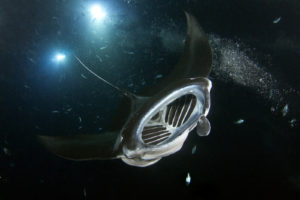
There are several spots around the world where you can do night dives with mantas. Lucky divers will see large feeding aggregations of dozens of mantas, unfolding like a nighttime ballet. These majestic animals swoop and fly, feeding on the plankton and small creatures that are drawn to the light of divers’ torches or the dive-boat lights. La Paz, Mexico; Raja Ampat, Indonesia; and Kona, Hawaii are some of the most famous spots for these encounters.
At night everything is different, even our perception. Not only does the darkness alter your sense of what’s around you, but it also enhances things like your perception of sound. Popular sites are usually far quieter at night, with fewer boat engines and less diver activity. Through this quiet, you start to notice natural sounds become amplified, such as the crackling and popping sounds that are far more pronounced than during the day. Various marine creatures produce the sound when they eat algae or coral polyps off the reef, combined with the sound of small shrimp snapping their claws. Keep your ears open during your night dives and you’ll hear a whole new world.
The post Five Great Night Dive Experiences appeared first on Scuba Diver Life.
The buddy system has been a cornerstone of recreational diving since its inception. Across the globe, instructors are training new open-water divers to make pre-dive safety checks in buddy pairs, practice descents and ascents in buddy pairs and learn their initial air-sharing skills in buddy pairs. This system has evolved thusly for many reasons, but are there flaws in the buddy system? And how do we mitigate them? First, the three most-often stated reasons for the current system are logistics, safety and fun:
For many divers, particularly novices, having a buddy to help put on or remove your scuba gear is invaluable. If a diver is struggling with a particular clip, release or awkward fin, a buddy can be very useful. Although an experienced diver may not need that assistance, those interactions can help keep a novice diver calm and confident before a dive when they may otherwise become flustered.
The buddy system began in an era of less-reliable scuba equipment. Modern scuba equipment, however, is extremely reliable when well-maintained, which removes some of the ‘safety’ consideration. But even taking that into account, a traditional single-cylinder recreational scuba set-up still has no redundancy. If, for example, a diver’s regulator fails or free-flows at depth, they must be able to rely on their buddy.
Similarly, if the diver has not monitored his gas consumption properly, he must rely on his buddy to share air. Finally, having an extra pair of eyes and ears can help nip a problem in the bud before it’s become something more serious. The buddy may notice problems before the diver himself — an unclipped reel or unsecured alternate-air source — and can help prevent more serious consequences.
We’re social animals and sharing an experience like scuba diving is part of the sport’s draw. After a great dive on a wreck or reef, the buzz can be palpable. Diving with a buddy allows you to experience something special as part of a group and that spirit of camaraderie is one of the attractions of a great diving trip.
As with most organizational systems, the buddy system has benefits and drawbacks. Ironically, the benefits of the buddy system listed above may also, inadvertently, become its flaws:
Dive guides, divemasters and instructors at many resorts are employed as guides who simply brief and lead dives. They are not there to retrain divers or act as their buddy. Therefore, if you’re traveling alone, the person who becomes your buddy for the dive is an unknown quantity.
While most resorts try to group divers of similar qualification and experience together when possible, there is no guarantee. However, you may find yourself buddied with someone who has vastly different skills and experience. It’s impossible to know if your new buddy has the same style of diving as you or how responsible they are. Will they disappear in the other direction with a camera? Are you confident to potentially put your life in this person’s hands? Dive qualification is not a guarantee of skill level. Do they have the same commitment to safety as you do? Will they be able to assist you in an emergency?
If you’re paired with a new buddy, discuss how you prefer to dive and undertake a thorough buddy check before entering the water. Understand their equipment configuration, controls and weight system, and ensure they understand yours. Discuss your alternate-air-source configuration and air-sharing procedures before the dive. Let them know where you prefer to position yourself in-water in relation to them and how fast you move when diving. Point out any peculiarities of your diving style or requirements. For example, if you have sensitive ears and must descend slowly using a descent line, let them know.
When a buddy pair is mismatched in qualification, experience, attentiveness or skill level, it can be a drawback for both people.
The less-experienced diver may feel intimidated by diving with a more-skilled diver, embarrassed to potentially compromise their buddy’s dive, or find themselves diving outside their comfort zone, in terms of physical fitness, depth, or skill level.
Photographers or videographers are often — unknowingly — some of the worst buddies, filming the whole dive with a camera on a stick, as opposed to maintaining spatial and buddy awareness. They can be less likely to pay attention, keep in contact, monitor their own gas consumption and no-decompression limits, or have the free hands to help in the event of a problem.
Experienced divers may feel aggrieved that they’ve paid for a dive trip, only to become an unpaid dive leader to a less-experienced buddy. They may resent the feeling that they must ‘hand-hold’ the novice both above and below the surface. Their dive may also be shorter due to the novice’s increased gas consumption or lack of skills. They may also lack confidence that a less-skilled buddy could assist in the event of an emergency.
This can create a problem even when the divers know each other well on land. Imagine a husband and wife buddy pair in which the wife is highly skilled and predominantly looks after her less-experienced novice diver husband in-water. This is potentially compromising if the wife has a problem, leaving her husband ill-equipped to deal with an emergency. Typical warning signs of this phenomenon are when one member of the buddy team undertakes all the dive planning, navigation and management. This behavior stunts the scuba growth of the passive buddy, turning the dominant buddy into crutch.
The buddy system is most effective when both divers have relatively equal skills and experience. They can share responsibilities and enjoy a mutual trust. If the incongruence is too great, one will become the dominant buddy while the other becomes a burden. Speak with your dive buddy. Share roles and responsibilities. Make sure you feel comfortable with the person you’re diving with. If you’re less experienced, skilled, out-of-practice or lack fitness, book suitable dives. Keep your skills fresh, try to maintain or rebuild fitness and — if you can’t — consider booking a private guide to give you the attention you require.
There is no clear-cut solution to some of the flaws in the buddy system. Is two the optimum number? Should you train to become a solo diver? Some say that three is a better number for a buddy team. This is because it creates a voting platform for decision-making and adds an extra pair of eyes.
Regardless of buddy-team size, train to be a better diver and better buddy. Keep your skills fresh. Maintain your fitness. Improve your skill level and, potentially, train to become more self-reliant diver. The skills you learn on a self-reliant or solo-diver course will serve you well as a dive buddy. Discuss key safety skills and procedures with the people you plan to dive with and share responsibilities. Doing so means that you can focus less on logistics and more on the dive itself.
The post Training Fundamentals: Flaws in the Buddy System appeared first on Scuba Diver Life.
Whether or not you’ve ever seen a shark on a dive and if you were “scared” are some of the most common questions scuba divers hear. To see a shark is an increasingly rare pleasure and privilege; the fishing industry kills an estimated 100 million sharks every year. Fins from up to 73 million animals become part of shark-fin soup. Overfishing has decimated some shark populations by up to 98 percent in the past 15 years, and the International Union for the Conservation of Nature considers almost 1/3 of pelagic shark species threatened.
And yet, the media still often wrongly maligns these magnificent animals. Misinformation, hyperbole and sensationalism are common currency, describing sharks as dangerous eating machines. In reality, leaving aside baited shark dives, they’re reserved and cautious when near divers. The risk of harm from a shark encounter is statistically tiny, but these are apex predators and thusly, divers should treat them with respect.
If you’re lucky enough to dive with sharks you can minimize your risks by practicing safe behavior around sharks. Here are our top tips for safe and enjoyable interactions.
Not all dive centers and dive buddies are created equal. If you’re diving somewhere with lots of potential shark encounters, choose a reputable and environmentally-focused dive operator. Investigate online. Look for positive reviews. Ask friends and colleagues who may have dived in the area.
Many operators adhere to strict best-practice codes to ensure the safety of environment, animals and the divers. Guides and divers should not aggravate or mistreat the shark during the encounter. Similarly, dive with a buddy you know and trust to behave well beneath the surface, both towards the animals and you.
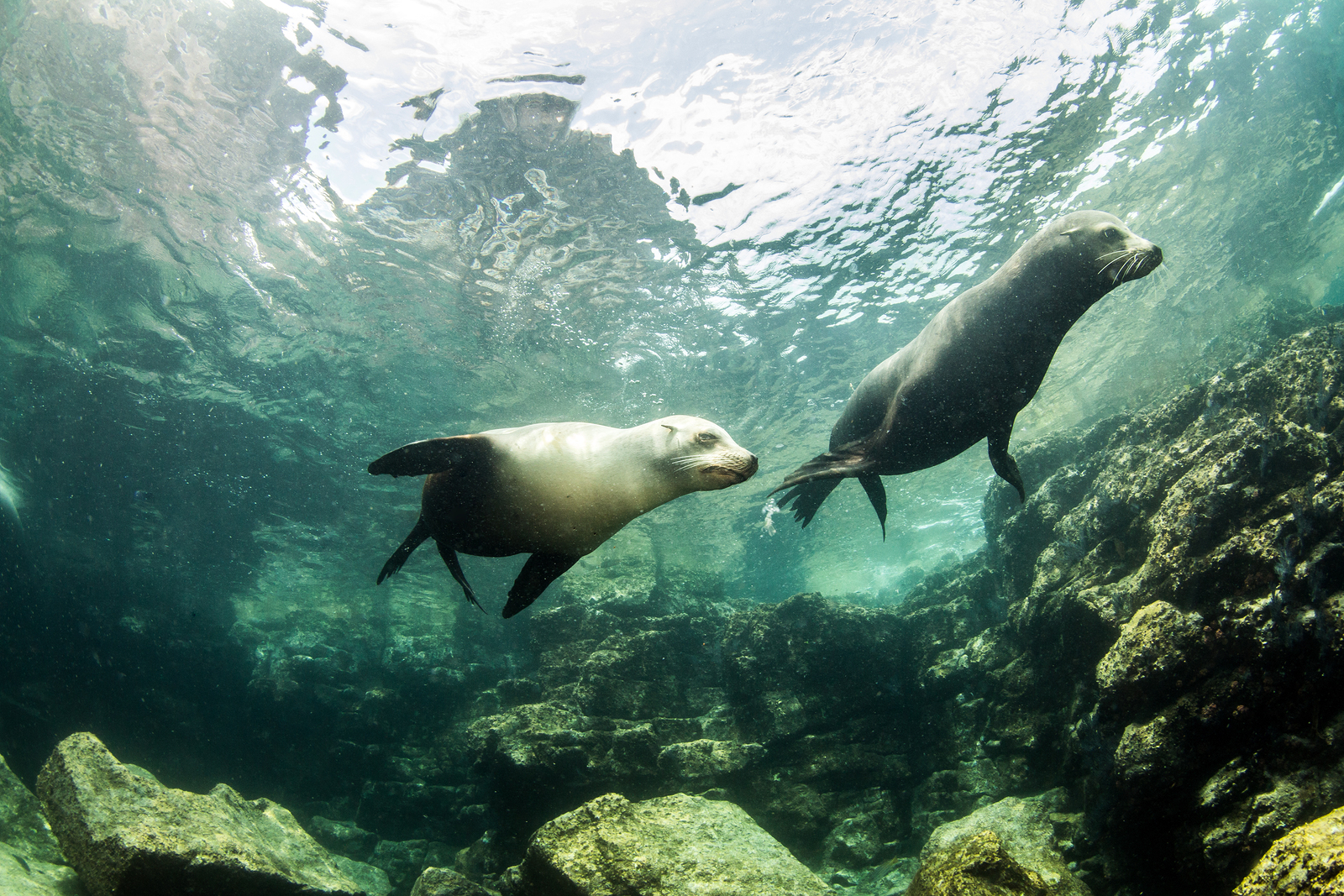
To have a successful shark encounter, first you must have a successful dive. Research and be comfortable with the dive environment. Be proficient with the dive’s conditions, whether that’s the water temperature, currents, visibility or equipment configuration.
Also, don’t dive in an environment or location where a shark is likely to mistake you for prey. If you’re diving in the center of a seal colony that’s the main prey of local sharks, you’re putting yourself at risk of being mistaken for a food source. Respect the environment and the shark’s territory and choose an alternative site when appropriate.
Dawn and dusk are prime hunting time for many types of sharks. There is likely to be more shark activity on a dive, but, conversely, a greater potential risk as they search for prey at those times of the day. Similarly, try to avoid shallow murky water. Bull sharks, in particular, hunt in these conditions and, if the shark cannot see the diver clearly — and vice versa — the risk of an accidental shark attack increases.
This may seem a strange tip in a sport where you can’t even speak beneath the surface. However, creating minimal disruption to the shark’s usual environment leaves you more likely to observe their natural behavior and reduces any potential risk to yourself. Enter the water gently. Use steps or a seated entry where possible, avoiding the usual crashing giant stride. If a giant stride is your only option, you can opt for a negative entry and immediately leave the surface.
In that vein, try to limit your time on the surface in general. Many predatory sharks feed on dead animals or animals in distress at the surface. Similarly, some sharks prey on animals that spend extended time at the surface, such as seals — hence the penchant some larger sharks have for surfers.
At the end of your dive try, when possible, to ascend and board the boat directly. Avoid long surface swims and don’t make unnecessary noise or splashes.
Move slowly and steadily beneath the surface. Relax your breathing and don’t approach or, worse, chase the shark. This will likely startle the animal and may provoke a defensive reaction.
Many diving experts recommend staying close the reef wall or seabed to avoid leaving yourself exposed. This habit has two advantages. First, a shark cannot startle you by sneaking up behind you outside of your field of vision – many sharks are ambush predators. Second, this helps ensure that a current doesn’t pull you out into the blue and separate you from the dive group.
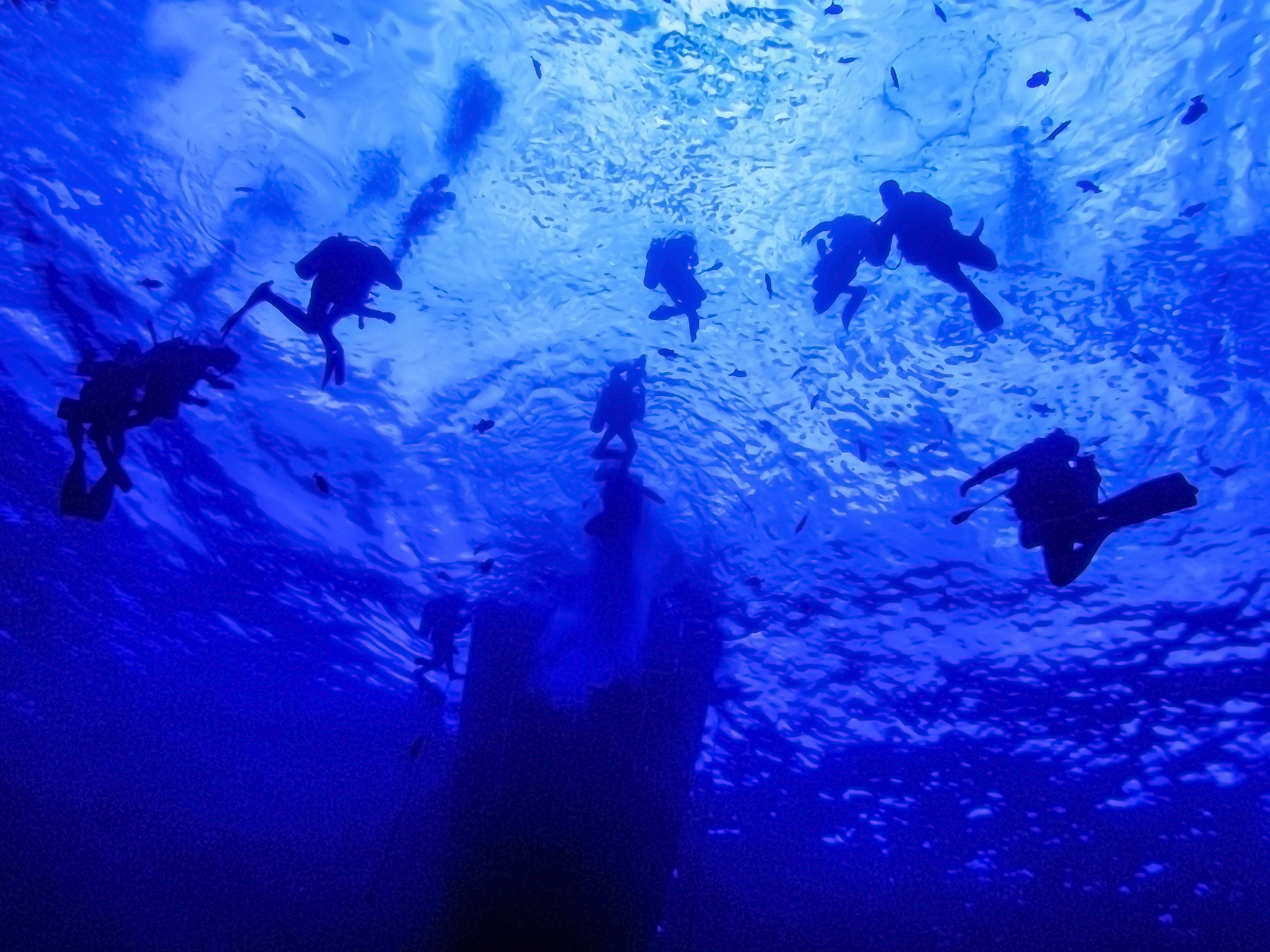
Dive in a group to ensure that there are always eyes not only looking for sharks but also monitoring the sharks’ and divers’ behavior. However, try not to dive in too large a group. Some sharks may perceive a large group of divers in close proximity as a single, large animal and a correspondingly greater threat. If you become separated from your buddy or group, rejoin your group — or any group — as soon as possible.
Consider yourself a respectful visitor to the shark’s environment. This is not a zoo — although you should be respectful there too, should you choose to visit one. The idea is to blend into the reef wall or seabed and observe the shark with minimal disturbance. In addition to entering and leaving the water quietly, try not to wear items that will mark you out to the shark. While there’s no definitive evidence that “yum-yum-yellow” wetsuit trim or fins attract sharks, it’s nonetheless best to avoid brightly colored wetsuits and jewelry as they may mimic the flashing of brightly colored prey.
Also, never “eyeball” the shark or flash your camera in its face, as this may aggravate it. There have also been reports that the whining of a flash re-charging attracts the animals quite close. Dive guides sometimes crackle a plastic bottle underwater by crushing and twisting it to create vibrations but note that this can sometimes stimulate feeding behavior. Humming gently may also make sharks more inquisitive and likely to swim by.
Do your homework. Research the behavior of sharks in your environment. Read reputable articles specific to the species. Speak with local experts and guides. Sharks generally move slowly and steadily, conserving energy. They are highly evolved, intelligent animals that will display warning signals if they feel threatened by a diver’s presence. If the shark illustrates a sudden behavioral change, this is a warning. Dropped pectoral fins, a gaping mouth, an arched back and increased speed are all signs to move close to the reef wall or seabed and, potentially, abort the dive.
Seeing a shark, or any other large pelagic animal, doesn’t change the laws of physics. Don’t let your camera distract you. Stay with your buddy. Keep a close eye on your gas consumption, no-decompression limits, depth and ascent rate. Keep your cool.
Diving with sharks is a wonderful, humbling and beautiful experience. If done correctly, you’ll minimize the risk to yourself, your buddies and the environment and get the chance to observe these beautiful creatures respectfully at relatively close quarters.
The post Safe Behavior Around Sharks appeared first on Scuba Diver Life.
