In 2008-2009, NASW issued a Policy Statement on Professional Self-Care and Social Work, calling self-care “an essential underpinning to best practice in the profession ." How are we doing a decade later?
from The New Social Worker Online — the professional social work careers magazine https://ift.tt/2SIe7Jx
Monday, March 4, 2019

Grow the Profitable Bridal Beauty Niche

A magical day that will be memorialized in photos for years to come, BIG Day hair and beauty is BIG business. Brides, and her attendees, want to look perfect for wedding day photos. As a beauty business, you are in the ideal position to help everyone look and feel their best. If you want more brides walking through your salon door, try these 8 tips to grow this profitable niche for your salon.
1. Add a Bridal/Wedding Services Menu
Create a separate Bridal Services Menu and tailor studio, salon, or spa services for the bride-to-be. It is a time when a bride-to-be feels the center of attention, so make them the center of YOUR attention.
- Bridal and Attendees Makeup Application
- Bridal Eyelash Extensions
- Bridal Spray Tan
- Bridal and Attendees Hair/Up-dos
- Bridal and Attendees Manicures and Pedicure
- Bridal Facial Package - facial services to help brides achieve a flawless wedding complexion.
- Bridal Massage Package - massage series to help brides achieve pre-wedding stress-relief.
- Bachelorette Spa Parties
To Do Tip: Offer a "Bridal Brow Rehab" as a bridal package, a series of shaping, threading, sugaring, or waxing services. Corrected brows are a Big Day must-have, it can take from 3-9 months to perfect and correct a bride's brows.
2. Add a Wedding Services Tab
Add a separate Bridal/Wedding Services page to your web site. Along with the bridal services menu and pricing, feature professional images of gorgeous brides and bridal parties - if they are your own, even better!
To Do Tip: Add a bridal image to your salon homepage slideshow. Your homepage is like your digital salon doormat - by adding an image of a bride you are communicating that your salon offers bridal services.
3. Share Bride Testimonials
Share wedding testimonials on both the salon website and social media channels. Testimonials demonstrate a proven track-record. To post to social media create a branded graphic image with the testimonial as a quote. Then share away.
To Do Tip: If you don’t have any testimonials, contact past clients and ask if they will write just a couple of sentences about their experience.
4. Target Brides Social Media Strategy
Create a social media strategy to target brides by posting a stream of bridal content for several months (March - June). Share bridal themed posts from beauty how-to’s, to bridal hair inspiration, to wedding planning tips.
To Do Tip: Facebook ads are a great place to start advertising special bridal offers and services.
5. Get The Word Out
Get the word out in your community that your salon offers bridal hair and makeup services to wedding planners, photographers, caterers, and popular local wedding venues. Word of mouth and referrals are one of your best wedding salon marketing tools.
6. Referral Cards
Provide key outlets and your team with branded bridal referral cards - hand out referral cards to the bridal party and friends of the bride. Weddings can be catching, so catch the next one!
7. Bridal Consultation
Trust is crucial for attracting brides to your salon. To build trust and put her at ease offer complimentary bridal consultations and a trial-run as part of your bridal package. It’s a bride’s big day, make her feel confident she will be camera-ready and picture-perfect.
To Do Tip: Request the bride to bring inspiration photos of desired hair and makeup.
To Do Tip: Request the bride to bring any headpieces or veils to be worn on head.
To Do Tip: Create a "look book" of bridal hair and makeup inspiration for reference during consultation, this, again builds trust.
8. Charge Generously
The secret to a lucrative wedding hair and beauty business is to charge correctly. If you offer exceptional bridal services charge generously for it. The key is to attract well-heeled clients who are happy to pay the right price for the right service.
To Do Tip: The value of your bridal services should be based on the fact that Saturday is the busiest day for a salon and the most popular day for weddings - so charge accordingly.
To Do Tip: If services are performed on-site they involve travel and convenience - so charge accordingly.
Vow to make this year’s bridal season the most successful one yet, attract the right brides to your salon for their big-day beauty needs.
from Beauty Business Blog https://ift.tt/2IQEOMD
Sunday, March 3, 2019
The Future of Social Work: Thriving, Growing, Leading
The Council on Social Work Education has led or been a part of three recent initiatives that give us an indication of what the future of social work might look like.
from The New Social Worker Online — the professional social work careers magazine https://ift.tt/2HecX6w
from The New Social Worker Online — the professional social work careers magazine https://ift.tt/2HecX6w
Five Great March Dive Destinations
Spring is just around the corner, offering the promise of longer days and much-needed sunshine. And why not start the new season right with a trip to one of these epic destinations around the world? Here are our picks for five great March dive destinations.
Tubbataha, the Philippines
Almost 386 square miles (100,000 hectares) of pristine reef in the Tubbataha Reef National Park mean spectacular diving in the Philippines at this time of year. It’s no surprise this special national park has received UNESCO World Heritage status.
Scuba diving Tubbataha is only possible by liveaboard. The short dive season runs from March to June, when the skies and seas are at their finest. Surrounded by thriving reefs and abundant marine life, diving here features numerous dive sites around three uninhabited islands.
Sitting in the Coral Triangle, there are around 350 species of corals. There are over 500 species of fish, plus 13 species of whales and 11 shark species at Tubbataha. The water is crystal-clear, the colors are vibrant and it’s a great destination for underwater photography. Huge schools of fish will engulf you. You might see green and hawksbill turtles, as well, plus mantas and eagle rays amidst the action.
One of the best things about this unique destination is that the diving is suitable for all experience levels thanks to the sheer diversity of dive sites.
Cuba
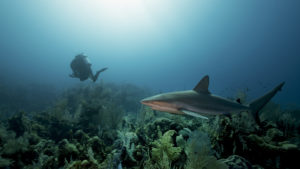
A silky shark in Cuban waters
Now that Cuba is more accessible, this warm-water destination is well worth visiting for varied diving and the best sea conditions in March. With over 3,400 miles (5500 km) of coastline and unique dive spots, there is something for every diver to enjoy.
A labyrinth of over 20 cave systems will keep adventurous divers happy. There are also wrecks, drop-offs, and the UNESCO-protected Jardines de la Reina. These ‘Gardens of the Queen’ form a chain of 250 coral and mangrove islands teeming with marine life.
There is an astonishing diversity of marine life in Cuba, thanks to its reef system forming part of the world’s second-largest coral reef. The mangroves are home to manatees and there are nearly 100 different species of sharks. You may also see numerous dolphin species, rays and 700 or so fish species. It is also possible to dive with whale sharks at certain times of year, with November being the best month for doing so.
This quiet and well-preserved dive destination has been less affected by tourism than other places, with just a handful of Cuba liveaboards operating. It’s best to book early, as a limited number of visitors can come each year.
Socorro Islands, Mexico
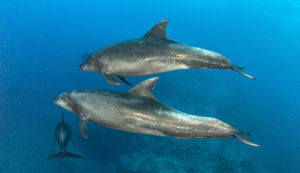
Dolphins in Socorro
If you’re a fan of megafauna diving, March is a great month to go scuba diving in Socorro. Surround yourself with ocean giants while making the most of winter’s calmer seas and great water visibility up to 164 feet (50 m).
This isolated liveaboard diving destination offers diving around a group of four volcanic islands sitting 250 miles (400 km) off the coast of Baja California. Futhermore, it’s a paradise for large pelagics. Being an ancient migration pathway for humpback whales, hundreds of these iconic whales arrive each winter and you can hear — and sometimes see — them while diving.
San Benedicto Island, one of the Revillagigedo Islands, offers the chance to dive with the world’s friendliest giant Pacific manta rays, known for their tolerance of divers and huge wingspans up to 23 feet (7 m) across. These fascinating rays congregate at submerged pinnacles and cleaning stations, coming close to divers as they pass by. You can also dive with pods of bottlenose dolphins as they follow the mantas and mimic divers’ movements.
Scapa Flow, Scotland
Scotland might not be at the top of every diver’s wish list, but it offers some of the best diving in Britain at the wreck-diving mecca of Scapa Flow.
Sheltered by surrounding islands, the waters at Scapa Flow form a calm, natural harbor in the Orkney Islands. A visit in March will see you enjoying the best visibility as you explore all this cold-water dive destination has to offer.
Once the former chief base of the Royal Navy, the islands held the German High Seas Fleet at the end of World War I until a German commander, fearing the vessels would be taken by the Allies, gave the order to scuttle the entire fleet. Fifty-two of those vessels remain there today and provide a wealth of wreck diving opportunities, including shallow and deep wrecks for all experience levels.
There are a number of dive operators offering charters to Scapa Flow and a PADI dive center on Orkney itself.
Micronesia
Most divers know all about Micronesia’s incredible diving and will easily name Palau and Chuuk Lagoon as two bucket-list destinations. But there are three other Micronesian hidden gems: Pohnpei, Kosrae and Yap.
Yap is all about the big animals, with the main draw being the year-round presence of graceful manta rays at a variety of dive sites. This coral-fringed island is also great for shark diving, featuring sharks at most dive sites. Fans of smaller critters will also be pleased, with colorful mandarinfish, pipefish and plenty of other macro highlights around. The easy currents and warm water make Yap diving suitable for all divers. The best time to dive Yap is during manta-mating season from December to April.
Once you’ve had your fill of Yap diving, hop over to Pohnpei. the ‘Garden Island.’ This rainforest-covered island has lush stretches of mangroves teeming with marine life, including abundant eagle rays and mantas. You can dive with all-black mantas and explore 11 marine protected areas with almost no one else around.
Kosrae completes these island gems, offering drop-offs, hard-coral gardens and sandy bottoms dotted with coral bommies. There is great muck diving as well, and technical divers can enjoy deep dive sites and WWII plane wrecks. Dive Kosrae and you’ll likely find yourself in the company of Micronesia’s manta rays and reef sharks, plus schools of tuna and giant trevally.
Divers and writers at LiveAboard.com contributed this article.
The post Five Great March Dive Destinations appeared first on Scuba Diver Life.
from Scuba Diver Life https://ift.tt/2TdHhWl
Saturday, March 2, 2019
My Sister and I: Connected by Social Work
My sister always knew where we were, because the profession of social work truly understands the “Importance of Human Relationships.” An essay on the social work core value: the importance of human relationships.
from The New Social Worker Online — the professional social work careers magazine https://ift.tt/2SGkbT0
from The New Social Worker Online — the professional social work careers magazine https://ift.tt/2SGkbT0
Friday, March 1, 2019
In Service of Unedited Life Stories
What led me to social work was a deeply personal experience that shaped my decision to focus my career on serving others. I was drawn to the core values and principles of our profession and our commitment to serving others.
from The New Social Worker Online — the professional social work careers magazine https://ift.tt/2IIlQaL
from The New Social Worker Online — the professional social work careers magazine https://ift.tt/2IIlQaL
Photographer Spotlight: Joanna Lentini
In this series of articles, we’ll shine a spotlight on some of the world’s best underwater photographers. Today we highlight Joanna Lentini.
[See image gallery at scubadiverlife.com]Tell us a little about yourself.
I began diving nearly 10 years ago, not knowing how different my life would become. I was living in Southeast Asia with my partner at the time, and for my birthday we went diving on the Great Barrier Reef. As I descended into that foreign world, I could not have been more terrified. But from that point forward, I learned to consistently conquer my fears. It was a turning point in my life. Even though I exited from that first dive feeling grateful that I made it back to the surface and certain I had enough, I continued to dive.
Living in New York now, I’ve been diving everywhere from the South Pacific to the High Arctic. I spend my time putting together stories related to underwater environments, wildlife photography, adventure travel and, more recently, conservation. I have been awarded by several international photography competitions, serve as the COO for the non-profit organization Oceans in Focus, and am a Nauticam ambassador. My work has been exhibited around the world and published in various publications.
How long have you been an underwater photographer?
I began shooting underwater in 2010 while I was based in Southeast Asia. With the Coral Triangle practically in my backyard, it was a better time than any to get certified to dive. Getting underwater changed everything for me. Once I got past a few of the apprehensions that I think many of us have when we begin diving, I felt completely at peace underwater. I started documenting my journeys through images and video; and I soon began writing about my experiences as well. I’ve now started organizing trips to encourage others to get out of their comfort zones and explore this amazing planet in different ways.
What got you interested in underwater photography?
I’ve always been interested in the oceans. But ultimately, the real inspiration came from too many hours of nature documentaries, such as “Blue Planet” and “Planet Earth.” I enjoyed watching the behind-the-scenes footage of the cameramen immersed in epic, natural events. One day I decided I wanted to stop watching others and learn to dive myself. But I didn’t want to simply dive — I wanted to shoot underwater. I really can’t imagine doing anything else.
What’s your favorite style of underwater photography?
I really prefer shooting wide-angle underwater. I love pelagic marine life. The sheer size of some of the creatures I get to meet never ceases to amaze me. However, that’s not to say I don’t appreciate or shoot macro images. From time to time I can get into a critter zone, but I am mostly too impatient to do it all that often. I have been trying to focus more on conservation photography. Putting together stories about conservation issues is the most important and rewarding way I can use my skills.
Any favorite subjects?
Without a doubt, my favorite animal in the ocean is the sea lion. They are super-inquisitive and make me laugh harder than anything else in this world. I could spend the rest of my days photographing them. Of course, I love sharks, and I have a new fascination with orcas as I just encountered a pod in Mexico this past year. Penguins are also pretty interesting creatures — I really love all wildlife.
Any favorite destinations?
I keep returning to the Baja Peninsula. It has an amazing array of life and particularly a great deal of pelagic life. Schooling fish, orcas, humpbacks, blue whales, scalloped and smooth hammerheads, makos, silkies, sea lions, dolphins, mobulas, mantas, and stingrays are just some of the creatures you can find there. The sun-scorched landscape and the people and culture also fascinate me.
What’s your underwater setup?
I shoot with a Canon 7D Mark II and a Tokina 10-17mm lens. I have other lenses and ports, but the Tokina is my go-to lens. My camera goes into a Nauticam housing and I use Inon Z240 strobes.
Do you have any tips for new underwater photographers?
Join trips that are geared toward photography or hire your own guide. There is nothing more frustrating than not having the proper amount of time with a subject that you traveled very far to photograph. When you find a subject to shoot, it’s important that you have enough time to set things up correctly. But don’t just focus on making an image — tell a story.
Find more of Joanna Lentini’s work on her Instagram and Twitter pages and her websites here and here.
The post Photographer Spotlight: Joanna Lentini appeared first on Scuba Diver Life.
from Scuba Diver Life https://ift.tt/2EDQJJp
Subscribe to:
Posts (Atom)