Thursday, March 7, 2019
VGTV's Elnaz Esmailzadeh on balancing UX and monetisation

from World News Publishing Focus by WAN-IFRA - World Association of Newspapers and News Publishers https://ift.tt/2SQQLl8

Underwater Photography Guide to the Great Barrier Reef
Scuba diving on the Great Barrier Reef is on most divers’ bucket lists for a reason. Hundreds of species of animals coexist with amazing, vibrant corals, which conspire to blow your mind. Subsequently, many people will want to capture their experience digitally so they can relive it on land. So here are few handy hints when it comes to underwater photography on the Great Barrier Reef.
Practice first
Whether or not you take your camera underwater at home before traveling, practicing with it first is essential. The Great Barrier Reef is amazing from the moment you submerge and thus you definitely don’t want to be mucking around with camera settings and buttons underwater. Take photos before the trip — lots of photos. Unlike some diving locations, it’s best to visit the GBR on a liveaboard. This means there is no nearby beach or resort pool to give the camera a spin first. It’s all action. So learn how to properly use your camera before you arrive.
Look around you
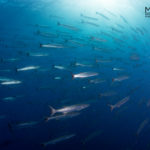
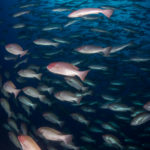
Make sure you look up every now and again when diving on the reef as you never know what will be swimming past up above. A school of barracuda or a minke whale might be right near the surface. Indeed, you may take some of your best photos may be taken during a safety stop as a dozen batfish surround you. So keep that camera on while relaxing in 15 feet (5 m).
Don’t ignore the whip coral
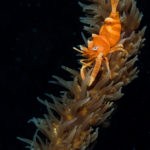
All over the reef you will encounter dozens of amazing whip corals poking out from seemingly random places. These beautiful, long tendril-like corals are also home to some of the most striking macro animals you are likely to encounter. Look carefully and you may spot a whip-coral shrimp combing the surface like a farmer tending to a field. Photographers often take their wid-angle setups down in the hope of snapping a turtle or a shark, but don’t forget that there can be some equally amazing macro subjects to snap away at. Ask your dive guide before descending which lens you should take on each particular dive.
Shoot shipwrecks
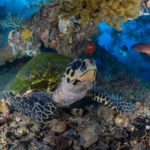
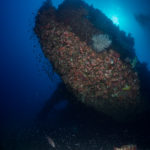
Sunken sea vessels always make for exciting dives, especially when they’re part of the world’s biggest reef. Turtles and sea snakes occupy every nook and cranny while stingrays and sharks spend time cruising atop the wreckage before resting inside. Make sure you take a video light or strobe with you when diving a wreck on the reef, as the best subjects are likely to hide just outside the realm of natural light.
Enjoy it
Don’t forget to enjoy the diving while you shoot away with your camera. All too often, underwater photographers concentrate so much on getting ‘that’ photo that they miss out on everything else that makes the reef so amazing. If you can’t get your setup to work, figure it out when you’re back on the boat as a good memory of the Great Barrier Reef is better than some bad photos of it.
The post Underwater Photography Guide to the Great Barrier Reef appeared first on Scuba Diver Life.
from Scuba Diver Life https://ift.tt/2HaYOYT
Courageous journalism recognised by haul of awards

from World News Publishing Focus by WAN-IFRA - World Association of Newspapers and News Publishers https://ift.tt/2IWq0ft
Wednesday, March 6, 2019
Inspired
Allan Barsky writes about being inspired by his students, the future of the social work profession.
from The New Social Worker Online — the professional social work careers magazine https://www.socialworker.com/extras/social-work-month-2019/inspired/
from The New Social Worker Online — the professional social work careers magazine https://www.socialworker.com/extras/social-work-month-2019/inspired/
Tuesday, March 5, 2019
Integrity for the 21st Century Social Worker
Even in the NASW Code of Ethics, the definition of integrity is only a starting point. We must go beyond the foundation of the Code of Ethics to fully embody the true meaning of integrity.
from The New Social Worker Online — the professional social work careers magazine https://ift.tt/2VCYhBV
from The New Social Worker Online — the professional social work careers magazine https://ift.tt/2VCYhBV
Colored gemstone heaven: AGTA GemFair 2019.

I have returned from the desert where I wandered for only four days but had my mind utterly blown by the glorious colored gemstone bonanza that is the AGTA GemFair™.
AGTA stands for American Gemstone Trade Association. Widely acknowledged as the world’s authority in color, AGTA and its members lead the industry in educational resources, ethical practices, and the finest colored gemstones and cultured pearls.
AGTA’s trade shows – especially the legendary annual Tucson GemFair™ – brings together the most spectacular colored gemstone and pearl dealers, while maintaining ethical standards that mean every business there is one you can feel good about supporting.
This was the third year I had the honor of serving as one of AGTA’s designated GemFair™ Gembassadors, charged with the sacred duty of sharing all the colored gemstone magic with those of you who couldn’t be there in person.
Continue reading Colored gemstone heaven: AGTA GemFair 2019. at Diamonds in the Library.
from Diamonds in the Library https://ift.tt/2C7ogtZ
Preserving America’s Underwater Battlefield: The Caribsea
From January to the end of August 1942, German U-boats attacked more than 285 vessels in North American waters. Just off coastal North Carolina, the remnants of many of these ships are scattered on the ocean floor. The remains of this little-known battlefield serve as the final resting place for 90 ships and nearly 1,700. Over the course of the Battle of the Atlantic, eight Allied convoy vessels, 78 merchant freighters, and tankers, and four German U-boats sank off North Carolina’s coast. Each shipwreck tells a unique story; today we visit the Caribsea.
The Caribsea sinks
In the eerie darkness of night, shortly after 2:00 am on March 11, 1942, the Caribsea’s second mate Hugh Spencer thought he saw a ship in the distance. As the captain peered through the bridge window, the glass suddenly shattered as a torpedo struck the ship. The Caribsea, a merchant ship loaded with 3,600 tons of manganese ore, was traveling north to Norfolk, Virginia. As it approached Cape Lookout, North Carolina, it slowed down to pass Diamond Shoals. About that time, U-158, patrolling in the area, spotted the slow-moving ship and fired one torpedo.
As the vessel began to sink, seawater flooded the foredeck and the alarm sounded to abandon ship. The Caribsea sank in just two minutes. This left no time to launch lifeboats or for the men to do anything other than jump into the ocean. As they dove into the cold water, the men clung to the oily wreckage. Minutes later, U-158 surfaced just 500 feet away and circled the area for hours but offered no assistance to the survivors. Finally, after about 10 hours, the steamship Norlandia found and rescued the seven survivors left of the 28-member crew.
Three days after it sank, an Outer Banks resident, Chris Gaskill, was walking along the beach of Ocracoke Island and found a frame with a certificate floating in the surf. He was surprised to find that it belonged to his cousin, Jim Gaskill, a third mate on the Caribsea. The next day, an out-of-town guest staying at the Gaskill’s inn came across a floating piece of wreckage with the name Caribsea etched on the side. Both items confirmed the Caribsea’s fate. Further, both offered a stark reminder as to just how close the war was to the United States.
Lethal attacks by the U-158 claimed the lives of 187 Allied merchant sailors, including those of the Caribsea. Disturbed by the bloodshed in the waters surrounding their homes, the people of the Outer Banks soon felt their grief turn into hatred for the German U-boats. When they heard that U.S. aircraft had dropped depth charges, sinking the U-158 in the North Atlantic, the people of the Outer Banks celebrated.
Diving the Caribsea
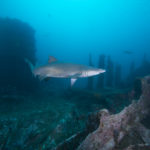
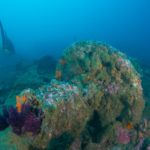

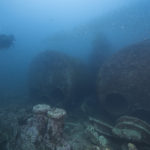
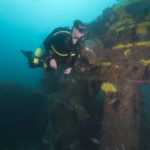
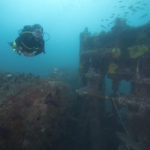
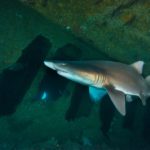
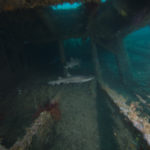
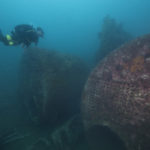
Resting in 85 feet (26 m) of water, 15 miles (24 km) northeast of Cape Lookout, the Caribsea is a popular recreational dive site. The wreck lies near the western margin of the Gulf Stream, which creates a favorable environment for abundant marine life. Spadefish, baitfish, amberjacks, stingrays, cobia, Spanish mackerel, sand-tiger sharks, and loggerhead turtles are just a few of the frequent guest on the Caribsea. Other highlights are the beautiful corals, sponges, and other colorful benthic organisms.
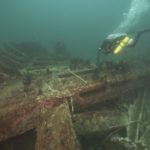
Although the site is known for its high and variable currents, visibility averages about 60 to 80 feet (18 to 24 m) year-round. As divers descend, the wreck comes into view, resting upon its keel on a flat, sandy plain. The ship measures 230 feet long (70 m) by 60 feet (18 m) wide, is contiguous and mostly intact. Some areas of the wreck site feature 20 feet (6 m) of vertical relief. The site’s main features are the bow and stern sections, and divers can recognize the shape of the hull with parts rising up 15 feet (5 m) from the seafloor. Other major features include the triple-expansion engine and two Scotch boilers, both located amidships. Look also for the anchor windlass, hatch beams, stem posts, and frames.
“The site offers great recreational diving for all skill levels,” says Tane Casserley, Monitor National Marine Sanctuary’s research coordinator and maritime archaeologist. “Most of the time, the site has good visibility and divers have the opportunity to see an abundance of marine life.”
As divers explore the Caribsea, they see a ship representative of the 78 merchant ships lost during World War II’s Battle of the Atlantic. Consequently, they will feel what it was like in 1942 off of coastal North Carolina, where the war truly came home to America. Learn more about the Caribsea here.
An Expanded Sanctuary
In an effort to honor the service and sacrifice of those lost during the Battle of the Atlantic, NOAA in 2019 will release a draft proposal to expand the boundaries of Monitor National Marine Sanctuary to include a nationally significant collection of shipwrecks that currently have little or no legal protection. The expansion would also establish the largest area designated as a World War II battlefield anywhere in the world.
To learn more about the proposal, click here.
By Shannon Ricles, Monitor National Marine Sanctuary
The post Preserving America’s Underwater Battlefield: The Caribsea appeared first on Scuba Diver Life.
from Scuba Diver Life https://ift.tt/2H1FSeG
Subscribe to:
Posts (Atom)