Wednesday, August 22, 2018
How to survive the online trolls

from World News Publishing Focus by WAN-IFRA - World Association of Newspapers and News Publishers https://ift.tt/2nZkoDX

Tuesday, August 21, 2018
WAN-IFRA and WEF mourn the loss of Otávio Frias Filho

from World News Publishing Focus by WAN-IFRA - World Association of Newspapers and News Publishers https://ift.tt/2LcIN25
Harwell Godfrey poison ring: dreamy, not deadly.

Do you know what a poison ring is, my darlings? They’re one of my very favorite unusual forms of jewelry: a ring with a hidden, hinged compartment that can hold small items like poison. Poison rings are so romantic and mysterious.
Most of the poison rings I’ve come across have been antique or vintage, but this modern poison ring by Harwell Godfrey is oh-so-dreamy.
Isn’t it a beauty?
It’s inlaid with mother of pearl, white onyx, and lilac enamel with a large and lovely central pearl.
Continue reading Harwell Godfrey poison ring: dreamy, not deadly. at Diamonds in the Library.
from Diamonds in the Library https://ift.tt/2BCYH62
Best Wreck Diving in Asia
Wreck divers take note: we’re about to start a six-part series on the world’s most dive-able wrecks. We’re starting with the best wreck diving in Asia, but stay tuned for articles on the U.S., Africa, Caribbean, Middle East and Europe over the next few weeks. For those who are properly certified, wreck diving can offer a window into history. These spaces are often eerie and mysterious, sometimes dark and gloomy, and always fascinating to explore. Here are our top 10 picks for some of the best wreck diving in Asia.
Fujikawa Maru
Where: Truk (Chuuk) Lagoon, Chuuk
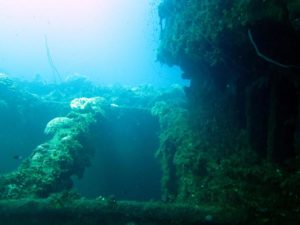
We’ve written extensively about Chuuk, and for good reason. There are so many dive-able wrecks here it’s hard to pick just one, but if we must, it’s the Fujikawa Maru. Converted from a cargo ship into an armed aircraft transport ferry by the Japanese Imperial Army, it went down during Operation Hailstone, when American forces attacked the Japanese fleet moored in Truk Lagoon.
The bow gun, fighter-plane fuselages and plane parts in the holds are all highlights. Check out the coral-covered telegraph annunciator and the famous air compressor nick-named R2D2. Qualified divers can penetrate the engine room via the staircase, though should take extreme care as part of the engine room has collapsed. There are also lots of small artifacts like gas masks, Mitsubishi aircraft wings and Zero fighter propeller blades. In 1974 a Japanese delegation placed a glass shrine with the crew members’ names on top of the bridge. The wreck is covered with beautiful hard and soft coral.
Depth: 30 to 115 feet (9 to 33 m)
Required qualification: The Fujikawa Maru is accessible to open water, advanced and technical divers with wreck certifications.
USS New York
Where: Subic Bay, Philippines
The USS New York made its maiden voyage in 1891 but was later commissioned for World War I. During this time, it escorted a convoy to France and assisted a British vessel after a German U-boat attacked. Early in 1932, the USS New York served in the Pacific fleet and was decommissioned a few months later. It was scuttled in Subic Bay in 1941 to prevent capture by the Japanese. The wreck is around 380 feet (117 m) long.
The wreck lies on its port side, with four huge, turreted deck guns and a propeller visible. Dense green algae are suspended in the water around the wreck. You might also spot large barracuda and perhaps even an eagle ray around the wreck.
Certified wreck divers can explore up to linear 130 feet (40 m) from the surface and must remain in the light zone, but this does allow them to enter the boiler room and part of the gun deck. Experienced, certified technical divers can explore further afield but must exercise extreme caution as there are blocked passages and extreme conditions.
Depth: 52 to 100 feet (16 to 30 m)
Required qualification: Advanced, wreck-certified divers can do limited penetration. Technical divers can fully penetrate the USS New York.
USAT Liberty
Where: Tulamben Bay, Bali, Indonesia.
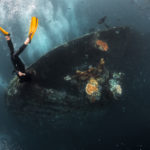
The USAT Liberty sits just offshore in sleepy Tulamben Bay, Bali. A Japanese submarine fired two torpedoes at the ship while it was crossing the Lombok Strait in 1942, but it didn’t go down. Two tugboats towed it to the beach at Tulamben where it sat, decaying on the shore until 1963 when an earthquake pushed it into the ocean. The wreck, now sitting on a sandy slope in 13 to 100 feet (4 to 30 m) of water, is 411 feet long (125 m) and rests on its right flank.
Coral and fish life cover the Liberty, and a number of humphead parrotfish, schools of trevally and leaf scorpionfish make their home there as well. The wreck is slowly disintegrating but you can still penetrate some of the cargo holds. You can also see the bow, some guns, boilers, toilets and the anchor chain.
Depth: 13 to 100 feet (4 to 30 m)
Required qualification: All qualifications can dive the Liberty but you’ll need wreck certification for penetration.
Irako Maru
Where: Coron, Philippines
The Irako Maru was a Japanese food-supply ship, built in 1937 and commissioned for troop transport and other wartime needs shortly thereafter. It went down in 1944 after sustaining heavy damage from the USS Seadragon north of Truk. It is mostly intact with swim-throughs around the deck and bow. Very experienced, qualified technical divers can penetrate the engine room. You can see large rice boilers and food mixers among other things. There are schools of trevally, fusiliers and an odd green sea turtle hanging around the wreck.
Depth: 100 to 148 feet (30 to 45 m)
Required qualification: The wreck is deep with strong currents at times. Divers should hold at least an advanced certification with a wreck specialty. Only technical divers trained in deep-wreck penetration experience should enter the wreck.
JAKE Seaplane
Where: Palau
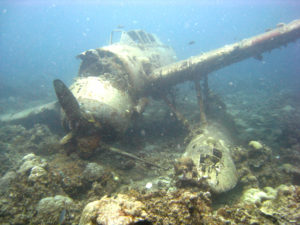
The wreckage of this Japanese seaplane, code named JAKE by the Allies during WWII, is 39 feet (12 m) long with a wingspan of 48 feet (14.5 m). A Palau fisherman spotted the plane from the surface in 1994, and shortly thereafter it became one of Palau’s most famous sites. Historians don’t know much about how the plane came to be here but think that it crashed with the engines off because the propellers are straight.
The wreck sits upright with the starboard wing bent at a 30-degree angle. The engine, tail and one of the pontoons have broken off from the fuselage and you’ll find them about 19 feet (6 m) north of the wreck. The wreck, engine, tail and pontoon are covered with coral. You can see artifacts like radios, ammunition and even a small bomb in the cockpit. Live ammunition could still be on the wreck, so divers should not touch anything (as per usual on a dive). Octopus, cuttlefish and nudibranchs all make their homes either on or near the wreck.
Depth: 40 to 50 feet (12 to 15 m) with the reef and sandy bottom sloping down to 130 feet (40 m)
Required Qualification: All dive levels
The King Cruiser
Where: Phuket, Thailand
The 279-foot (85 m) King Cruiser used to be a Japanese car ferry, later operating as a passenger ferry that ran between Phi Phi and Phuket. In 1997 it struck a reef on the way to Phuket and sank with over 100 passengers on board. Luckily, they all survived. Today, the wreckage sits upright but is too unstable to penetrate. There’s lots of marine life around the wreck, however, including large schools of snappers, barracuda, rabbitfish, fusiliers and goatfish.
Depth: 40 to 115 feet (12 to 35 m)
Required qualification: Due to strong currents and bad visibility at times, this is a dive for experienced divers. Penetration is not recommended.
Duke of Sparta
Where: Ambon, Indonesia.
The Duke of Sparta remained unidentified for many years until the manager of a local dive resort found a plaque on a steam boiler bearing the machine’s serial number. It became the SS Aquilo in 1951 and was bombed as part of a clandestine CIA operation against Indonesian communists in 1958. The ship sits in a busy part of the Ambon harbor, which makes visibility iffy.
The wreckage is, however, mostly intact and thus penetration is possible for wreck-certified divers. You can visit the stern, aft deck house and see the aft cargo winches. There is a diversity of tropical marine life including reef octopus, scorpionfish, frogfish and moray eels.
Depth: 50 to 164 feet (15 to 50 m)
Required qualification: Open water and above. Only divers with a wreck specialty should penetrate the wreck.
SS De Klerk
Where: Labuan, Malaysia
There remains no consensus on how the SS De Klerk sank. One theory posits that the Dutch scuttled this steam engine in 1942 to keep the Japanese from gaining the vessel. The Japanese salvaged it, however, and renamed it the Imabari Maru, which sank after striking a mine sometime between 1944 and 1949. The vessel was transporting slave labor from Singapore to Manila when it sank. A different story claims the Australian Air Force sank the ship.
The wreck is on its port side with a large hole blasted into its starboard side. Divers could formerly see a steel propeller at the stern, although it’s now partially covered by sand. The ship is intact but collapsing in on itself. You can see various war artifacts, china crockery and bottles. You may also see some human remains so it’s important to treat the site with respect for those who passed.
Depth: 66 to 115 feet (20 to 35 m)
Required qualification: Advanced and wreck-specialty divers
Sagiri
Where: Kuching, Malaysia
The Sagiri was a Japanese battleship sailing towards Kuching in order to take control of Borneo in 1941. The Dutch armed forces attacked the ship and it’s one of five they sank during this battle. Divers have discovered only three of the sunken ships so far.
Most of the wreck is still intact but sustains damage during each new monsoon season. You can see guns and ammunition on the deck, as well as parts of the engine and signal lights. Hard and soft coral covers the wreck.
Depth: 85 to 104 feet (26 to 32 m)
Required qualification: Advanced to experienced divers with at least 50 logged dives due to the depth, strong currents and visibility on the wreck. Only wreck divers should penetrate the wreck.
Dona Marilyn
Where: Malapascua, Philippines
The Doña Marilyn was a passenger ferry running between Cebu and Manila that sank in 1988. The tragedy resulted in a great loss of life, leaving 389 dead and 147 survivors.
The wreck is 328 feet (100 m) long, intact and resting on its starboard side. There are long fishing nets wrapped around parts of the wreck and you’ll likely see scorpionfish, nudibranchs, schooling fish and the occasional ray. The wreck is fully penetrable if you’ve got the qualifications.
Depth: 65 to 108 feet (20 to 33 m)
Required qualification: Advanced or higher
The post Best Wreck Diving in Asia appeared first on Scuba Diver Life.
from Scuba Diver Life https://ift.tt/2PsewzG
Monday, August 20, 2018
Self-Care Summer: The Social Work Tide
Take time out and watch the current of social work's tide. A poetry entry in the Self-Care Summer series.
from The New Social Worker Online — the professional social work careers magazine https://ift.tt/2N60p1o
from The New Social Worker Online — the professional social work careers magazine https://ift.tt/2N60p1o
Eco-Friendly Alternatives to Plastic Straws
Plastic straws aren’t recyclable. In the United States alone, we waste 390 million of them  every day according to Get Green Now. Often made from polypropylene, a byproduct of petroleum, it takes an incredible amount of energy and natural resources to manufacture these straws. Worse yet, we can’t recycle plastic straws due to their size and weight. In the best-case scenario, they end up in landfills, lasting 200 years before degrading down into smaller pieces. But no matter where they end up, they will never disappear from Earth. Sadly, an incredible number of them end up in our oceans, killing marine life and birds at an alarming rate.
Terrible for the environment, straws are also bad for your body as the Washington Post notes, “causing gas and bloating, increasing the likelihood of cavities, and leading to excess sugar intake and wrinkles around your mouth.”
Emerging science also demonstrates that toxins can leach out from plastics into our drinks. Acidic beverages — the drinks we often consume with straws — release even more toxins from the plastic. These include soda, lemonade, orange juice, and cranberry juice, along with limes and lemons in alcoholic drinks.
The best alternative to plastic straws is to avoid using them entirely. Encourage the bars and restaurants you visit to only offer straws upon request. As an experiment, we vowed to abstain from straws for a month. Strange at first, it soon became an easy habit to adopt. We were shocked that we felt less bloated — that excess air you suck in with each sip from a straw quickly adds up. We urge you to try this first before anything else. However, if you continue to prefer straws or require a straw due to a physical limitation, we’ve compiled the list below of eco-friendly alternatives.
Glass straws
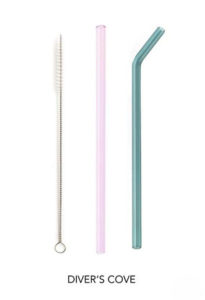
Recyclable and a more-eco-friendly material to manufacture, glass straws come in a variety of fun colors and different sizes/shapes. Glass also remains cool when you use it for either hot or cold drinks. While not indestructible, these straws remain sturdy enough for daily use and their transparency can help you get them clean. Sleeves protect these straws in transit and allow you to carry the accompanying cleaning brush. We like the glass straws from Simply Straws, which offer a lifetime guarantee. The company makes their straws from borosilicate glass, the strongest available. You can customize colors, but we adore their Diver’s Cove set.
Stainless-steel straws
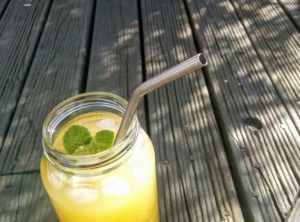
Stainless steel straws last for a long time yet remain recyclable and their silvery color makes a stylish addition to any drink. Look for straws with 18/10 stainless steel. This is the same material used for cutlery and it won’t rust or break and usually leaves no metallic aftertaste. Stainless steel conducts heat and cold, which can be refreshing in the case of icy drinks. You will, however, need to wait for your hot drink to cool before consuming it if you’re using a stainless-steel straw. We like the handcrafted stainless-steel straws from Mulled Mind, made in the U.S. The company ships them in recycled/reused/biodegradable materials and includes a lifetime guarantee. Mulled Mind sells a variety of shapes and sizes, but also offers custom straws if you’re looking for something specific.
Silicone straws
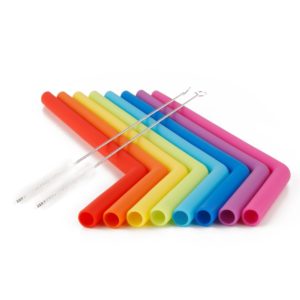
Though neither eco-friendly in terms of production nor recyclable, you can nonetheless use the same durable silicone straw for many years. Inexpensive compared to many alternatives, they come in a variety of colors and shapes. Foldable, flexible, and highly portable, you can squeeze silicone straws into even small lid openings. You won’t taste rubber or cause damage if you accidentally bump the straws against your teeth. We like the eight-pack of silicone straws from Hiware, which sells a size perfect for 20- to 30-ounce tumblers and includes two brushes along with a lifetime guarantee.
Organic bamboo straws

Manufacturers construct bamboo straws from a single bamboo stalk, making them an unusual alternative. They’re both marine-friendly and compostable if you choose an unfinished, organic brand. Handcrafted and free of dyes, these straws make a beautiful conversation piece. Because bamboo is a natural material, these straws will eventually fray and splinter. However, you can increase their life span by removing them from liquid when you’re not using them. We like this set of six organic bamboo straws from Bambu, which also includes a natural brush made of sisal.
Straws made from straw

The by-product of flour and grain production, drinking straws fashioned from straw don’t require farmers to grow additional plants. Instead, the stems of grain that would otherwise go to waste after harvesting are repurposed into more-eco-friendly single-use straws. Naturally compostable, these straws also require less processing than paper during the initial manufacturing process. Amazingly, you can drink hot beverages from these straws, and even celiacs can sip from the certified gluten-free versions even though they’re made from wheat. However, the straws aren’t ideal for thick drinks such as smoothies due to the narrow stems. We like HAY! Straws, which come in both short and tall sizes as packs of 100.
Paper straws
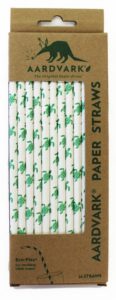
Popping up in many restaurants and bars as a more eco-friendly, compostable, and commercially viable alternative to plastic, paper straws are also an option for personal use in cold drinks. Available in countless fun designs, paper straws decompose in just 30-60 days. Some paper straws also come in bendable versions. However, paper straws still require trees and there’s an intensive manufacturing process to turn the wood pulp into paper.
When considering paper straws, it’s important to determine whether the company manufactures them with bleach or harmful dyes, waxes, and glues. We like Aardvark’s paper straws which use none of these, are made in the U.S., and last the longest in liquids — around two to three hours. They remain the only paper straws on the market made with food-grade inks and paper that’s both marine-degradable and compostable. Sold commercially by the giant case, Aardvark’s paper straws are available on the retail side directly from the company in their cute sea-turtle pattern and in a variety of designs from other retail stores listed on their web site.
Other alternatives
While the straws listed above are tried and true methods to help keep some plastic out of the ocean, the alternatives listed below are also worth considering.
FinalStraw
With a wildly successful Kickstarter campaign, this collapsible straw from FinalStraw has become the darling of the reusable straw movement. The fun introduction video features a mermaid showcasing the stainless-steel straw, quickly folding up into a compact case that attaches to your key chain. Tipped with food-grade silicone so it doesn’t damage your teeth on accidental impact, you clean it with a squeegee you pull through the straw. While they make the inside of the straw from thermoplastic elastomer (TPE) tubing, the world considers this a more-eco-friendly solution as it’s recyclable and requires less energy for production. Though unavailable until November, we already adore their marine-friendly colors including their “Shark-butt Grey,” “Healthy Coral,” and “Sea Tur-teal” shades.
Pasta straws
Straws made from uncooked pasta compost quickly while still holding up to a cold drink for hours. Some bars and restaurants around the world use them exclusively in lieu of plastic straws so these straws could be a viable alternative for you if you can source them. We’ve found hollow bucatini pasta and long ziti in Italian specialty stores, but only at a higher price point. Another alternative is the PastaStraws company, however, we haven’t tried them as their products are currently out of stock.
Lolistraws
Loliware touts their seaweed-based, edible straws as “tasty, marine-degradable, and hyper-compostable.” After a fully-funded Kickstarter campaign, they are continuing pre-orders via Indiegogo InDemand. While we cannot verify their claims as the straws aren’t yet available, the idea for these is fueling the imagination of many.
Compostable straws
While compostable straws seem a smarter option than plastic straws at first, they are still a single-use product and — shockingly — are often no better than regular plastic straws when dumped into a marine environment. As the Huffington Post reports, compostable straws are designed to break down in high-temperature industrial-compost facilities, not in salt water, landfills, or personal compost heaps. Instead of using regular trash or recycling bins to dispose of compostable straws, you must compost them via commercial facilities. In addition, supposedly compostable straws aren’t always biodegradable, so you’d need to buy only products certified by the Biodegradable Products Institute.
The post Eco-Friendly Alternatives to Plastic Straws appeared first on Scuba Diver Life.
from Scuba Diver Life https://ift.tt/2vWNpVe
Sunday, August 19, 2018
Swimming with Leatherback Turtles in Costa Rica
Costa Rica takes environmental stewardship seriously, protecting 26 percent of its land in some form of conservation. Visitors flock to the rainforests, volcanoes, beaches and of course dive sites. But during certain times of year the beaches host not only to human visitors, but also hundreds of nesting and hatching sea turtles.
Both the Pacific and Caribbean coasts of the country attract various species, including green, hawksbill and olive ridley turtles. Leatherback turtles, however, are undeniably the most impressive. The largest of all the sea-turtle species can reach a gigantic 7 feet (2 m) in size. Leatherbacks can weigh up to 2,200 pounds (1000 kg). The individuals on Costa Rica’s Pacific coast are some of the largest on record.
Once the leatherbacks begin their ocean migrations, scientists have discovered that these turtles are one of the deepest divers of any marine creature, feeding on various species of jellyfish and pyrosomes. They also live quite long, with a life span of up to 100 years.
Leatherback nesting habits
Unlike most other marine turtles, leatherbacks don’t always return to the same hatching grounds year after year. In fact, female leatherbacks tend to lay their egg clutches around the same region of a specific area, but not the same beach. They seem to choose partially based on topography, preferring sandy to rocky beaches as rocks can easily damage their soft shells.
Visitors can observe nesting leatherbacks almost all year, depending on where they are. On the Caribbean side of the country, leatherbacks nest from March to July. On the Pacific side from September to March.
Las Tortugas Research Station on the Caribbean coast offers visitors the chance to peacefully interact with these giants as they come to and from the beach. Visitors cannot roam the beaches after 6 p.m. as most of the turtles lay their eggs after dark. For this reason, you must go with a guide as eggs and turtles are easily disturbed.
Swimming with leatherback sea turtles
In terms of swimming with the leatherbacks a huge amount of luck is involved. Yet if one is in the right place at the right time and respects the turtles and their nesting and hatching sites, the Costa Rican coasts doubtless the best place in the world to encounter these giants in their natural environment. Snorkeling off the coasts of Tortuguero on the Caribbean coast and Playa Grande on the Pacific will provide visitors their best chances of swimming with leatherbacks.
The post Swimming with Leatherback Turtles in Costa Rica appeared first on Scuba Diver Life.
from Scuba Diver Life https://ift.tt/2OO78x9
Subscribe to:
Posts (Atom)