Social workers often practice in community settings, but how often do they actually transform the settings? The University of Georgia School of Social Work and the Athens Clarke County Library are working together to create a trauma-informed library.
from The New Social Worker Online — the professional social work careers magazine http://bit.ly/2SFjlK7
Sunday, February 10, 2019

Saturday, February 9, 2019
Should We Boycott Diving in Modern Whaling Nations?
Most divers have heard of Japan’s Okinawa Island and Iceland’s Silfra Fissure. Norway has also become a recent hotspot for in-water orca encounters. However, especially in light of recent news that Japan plans to resume commercial whaling and withdraw from the International Whaling Commission (IWC) to do so, should divers consider boycotting these whaling nations and take our business elsewhere? Japan, Norway, Iceland and the Faroe Islands continue to slaughter whales for various dubious reasons. Should this be an issue for divers? We each have an opinion, whether you consider whaling justified due to cultural symbolism or simply a barbaric ritual long-since outdated. Here we’ll discuss why you may (or may not) want to boycott modern whaling nations.
Whaling in Japan
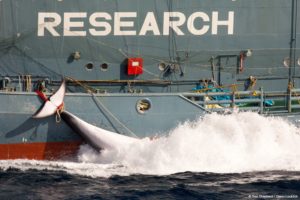
BB tries to stop whale loaded on Nisshin.
© Sea Shepherd/Glenn Lockitch 2013
Before the IWC worldwide ban on commercial whaling came into effect in 1986, many countries, including the United States, hunted whales. Hunters sought sperm whales in particular for their meat, oil and bone. Japan remains by far, however, the world’s holdout when it comes to disregarding the whaling ban.
Japan never stopped hunting or killing whales. In fact, for many years the nation conducted commercial hunts in the northern Pacific and Southern Ocean under the cloak of “research.” In 2017, the Japanese fleet departed twice and slaughtered over 300 minke whales, 122 of which were pregnant and 114 of which had not reached maturity. Fin whales, sei whales and Bryde’s whales also fall victim during the annual season, albeit in smaller numbers.
Cultural significance of whaling in Japan
While whaling in Japan is doubtless alarming on many levels, whales have culturally been a food source there since at least 676 AD, when Buddhism considered the ingestion of land animals unfit. Therefore, hunters looked to the sea. By the Middle Ages, whale meat was highly prized.
As of today, minke whale populations are not threatened. The IWC has calculated that whaling fleets could take 2,000 minkes per year for 100 years without adversely affecting stocks of that particular species. Scientists estimate the Antarctic population to exceed 760,000 individuals and it has grown 9.5 times over the last century.
Modern Japan and whale meat
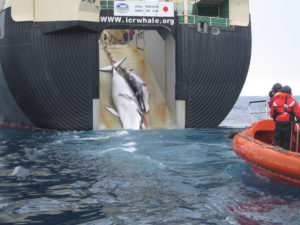
Image above: An adult and sub-adult Minke whale are dragged aboard the Nisshin Maru, a Japanese whaling vessel. The wound on the calf’s side was reportedly caused by an explosive-packed harpoon. This image was taken by Australian customs agents in 2008, under a surveillance effort to collect evidence of indiscriminate harvesting, which is contrary to Japan’s claim that they are collecting the whales for the purpose of scientific research.
In modern Japan, whale meat is sold to schools, hospitals and areas of deprivation because whale meat is now cheaper than ground beef. Overfishing, and the near-eradication of species such as bluefin tuna, has forced the Japanese government to organize marketing drives to promote the consumption of unpopular whale meat.
However, scientists have discovered high mercury levels in the meat, which can result in hazardous side-effects such as birth defects. This factor, combined with the mass-killing of juvenile and pregnant minke females in the Antarctic and North Pacific, makes the killing redundant in modern times. In terms of scientific value, in 2014 the Australian court ruled that Japan’s whale slaughter in the Antarctic violated the International Convention for the Regulation of Whaling. The convention stated that their actions were not ‘for purposes of scientific research,’ thus making their entire justification for whaling null and void.
Norway and Iceland
Until Japan decided to begin commercial whaling again, Norway and Iceland were the only countries in the world to officially endorse commercial whaling. While Japan claims to kill whales for research purposes. In the face of well-publicized opposition, Norway and Iceland both increased their quotas in 2018. This was despite multiple sources confirming that most of their populations despise whale meat. Additionally, Japan — the main importer of whale meat from Norway and Iceland — has reported warehouses of unused meat rotting away and refuse to purchase any more. In fact, the Norwegian government subsidizes the whale hunt and gave the industry $880,000 dollars in 2002 to dispose of excess whale blubber, which eventually made its way to dog food.
Whaling is a dying industry in Norway and Iceland where whaling boats have decreased from several hundred to a handful. With climate change causing whales to move further offshore in the search of krill, there may very well be no whale industry in future decades. But for now these three nations are steadfastly holding onto a fading tradition.
As divers, it’s up to each of us to decide if we want to avoid travel to these destinations. If you do forgo a trip to Norway, Iceland or Japan for this reason, make sure to let the operator that you would have dived with, or the hotel where you would have stayed, for example, know why you’re not coming. Change must come from within the populations themselves. Consequently, if other industries are losing money because of continued whaling, governments are far more likely to listen.
The post Should We Boycott Diving in Modern Whaling Nations? appeared first on Scuba Diver Life.
from Scuba Diver Life http://bit.ly/2SCYwPD
Thursday, February 7, 2019
Four Tips on How to Equalize Your Ears
Many people struggle to equalize their ears when they dive. They erroneously think they have an ear problem and many stop diving before even giving it an honest try. But much of the time we can attribute this failure to equalize to using the wrong techniques or improper execution of what they have learned. Here we’ll share four easy techniques and tips on the best ways to equalize your ears.
Is it really an ear problem?
People often say they have a problem with their ears and are not sure they can dive. While some people do have a medical issue with their ears or sinuses, that’s not true most of the time. So why do so many people struggle when equalizing their ears?
In most cases, it’s because someone has, for example, experienced ear problems in an airplane or when they went swimming. Especially on an airplane, people feel the pressure change on their ears as discomfort or pain. In most cases, however, it’s because of an ear problem, but rather that they just haven’t properly learned how to equalize.
Why must we equalize when scuba diving?
As soon as your head dips below the surface, water will flow into your ears. This puts pressure on your eardrums. For most people this isn’t painful in the first few feet, but if you don’t equalize your ears, the pressure keeps building from discomfort even to pain. To solve this problem, we must equalize our ears by adding air into our sinuses and Eustachian tubes to counter the water pressure.
The Valsalva maneuver
The first tip to successfully equalize your ears is to use the Valsalva maneuver. This is by far the easiest and most common technique for scuba diving. To do this correctly, pinch your nose with your fingers and then gently blow air into your sinuses. This works because with your nose pinched closed and your mouth on your regulator, the air has nowhere else to go but through your Eustachian tubes and your eardrums. You must not blow too hard or you can damage your ear.
If this doesn’t work on the first try, ascend a little bit and try again. If that still doesn’t work, try the second-best equalizing technique: swallowing.
Swallowing can help
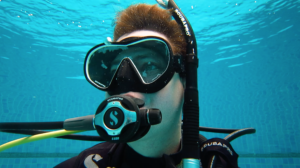
Swallowing when underwater helps equalize your ears
Candy or gum help when you fly because chewing on them makes you swallow, which in most cases will equalize your ears. Some people even prefer to swallowing over the Valsalva maneuver to equalize their ears while scuba diving.
Wiggle your jaw
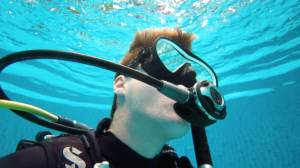
Wiggle your jaw from side to side
The third tip is to wiggle or move your jaw from side to side. This stretches the Eustachian tubes, which can equalize your ears.
You can also try to move your head from side to side or even attempt all equalizing techniques at the same time or any combination you find helpful.
The last tip is a bit uncommon: blow your nose underwater.
Why does blowing your nose help?
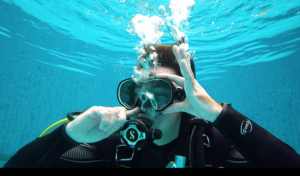
Blowing your nose can help clear your ears
May people have sinus congestion, which can block the Eustachian tubes. This makes it impossible to blow air into the eardrum. By blowing your nose underwater you remove that congestion, allowing any of the equalizing techniques described above to work well.
To do it, keep your mask on your face and gently but steadily blow your nose, one nostril at the time. This will create some congestion in your mask. Just clear it by exhaling through your nose and then afterward pinching your nose to do the Valsalva maneuver.
Combined with some patience, equalizing techniques should work for most people, even those who think their ears are keeping them from enjoying the underwater world.
Guest author Marcel van den Berg is a PADI Platinum Course Director at Sairee Cottage Diving in Koh Tao, Thailand. Subscribe to their YouTube channel here.
The post Four Tips on How to Equalize Your Ears appeared first on Scuba Diver Life.
from Scuba Diver Life http://bit.ly/2De8Fsi
Indian media fights fake news in run up to Lok Sabha elections

from World News Publishing Focus by WAN-IFRA - World Association of Newspapers and News Publishers http://bit.ly/2THTKxL
Wednesday, February 6, 2019
“Beautiful Boy”—A Film Beyond Acting: Raw, Real, Revealing
The film Beautiful Boy provides a real life portrayal of a father and son’s descent into hell as the son becomes addicted to drugs. It also provides important avenues for social workers to discuss addiction issues among ourselves and with clients.
from The New Social Worker Online — the professional social work careers magazine http://bit.ly/2GrBt3H
from The New Social Worker Online — the professional social work careers magazine http://bit.ly/2GrBt3H
Time for AGTA GemFair Tucson!

Hello, my darlings!
I’m off to the desert to see the finest colored gemstones and pearl jewelry that the fine folks of the American Gemstone Trade Association (AGTA) have to offer.
If you’ve been following Diamonds in the Library for a minute, you can guess exactly how excited I am to be returning to the AGTA GemFair in Tucson as an official AGTA Gembassador.
Here I am communing with the local flora at last year’s GemFair. It’s an honor – and a whole lot of fun – to be asked to help share this utterly luscious and industry-only colored gemstone extravaganza with you once again, my dears. I can’t wait!
I’ll be doing a full blog post recap of all the vivid wonders that AGTA GemFair has to offer after I come home, but if you don’t want to miss a thing you should follow along on Instagram on both the @AGTA_Gems account (I’ll be doing a takeover!) and the #AGTAGemFair19 hashtag.
Continue reading Time for AGTA GemFair Tucson! at Diamonds in the Library.
from Diamonds in the Library http://bit.ly/2GycU5t
Tuesday, February 5, 2019
Explorer Ventures Adds New Red Sea Itinerary and New Maldives Yacht
Expanding into new waters, the Explorer Ventures Liveaboard Fleet adds an incredible itinerary in the Red Sea and a new yacht in the Maldives. Known for excellence in service, Explorer Venture’s latest liveaboards, Grand Sea Explorer and Emperor Explorer are specifically designed for luxury. These contemporary vessels will provide tranquil cruising throughout two of the world’s most exotic, iconic diving destinations. Red Sea departures are already available for 2019, and departures in the Maldives launch this August. Explorer Venture’s growing fleet is now comprised of eight liveaboards in seven destinations worldwide.
The Grand Sea Explorer
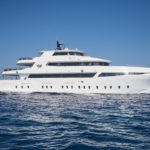


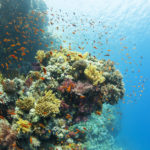
The Grand Sea Explorer joined the fleet this January. At 134 feet (41 meters) in length, it is the epitome of luxury. Intended for pampering guests, it provides a level of service found nowhere else in the Red Sea. The Grand Sea Explorer’s 7-night itinerary takes guests through the Brothers Islands, Daedalus Reef, and Elphinstone Reef Marine Park sites. Divers can expect technicolor reefscapes and sightings of thresher sharks, whale sharks, mantas, oceanic whitetips, and hammerheads. Rounding out this new Red Sea itinerary is a must-do land extension to sightsee the pyramids in Cairo.
The Emperor Explorer
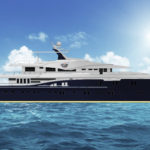
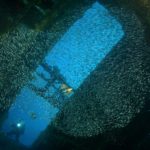
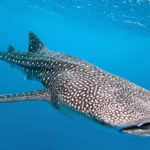
This August, Explorer Ventures, in partnership with Emperor Maldives, will launch the brand-new Emperor Explorer in the Maldives. Offering modern and spacious accommodation, the 138-foot (42 meters) yacht accommodates 26 guests in 13 contemporary cabins. On Emperor Explorer, guests will not only dive on the abundant coral reefs of the central atolls, but also have the opportunity to observe the world’s largest known population of reef manta rays. Whale sharks are seen year-round, and special itineraries allow you the chance to see elusive thresher sharks. Seven & 10 night trips are available for individual & full charter bookings.
To learn about Grand Sea Explorer, Emperor Explorer, or read more about Explorer Ventures other destinations worldwide, visit the website here.
____
About Explorer Ventures
The Explorer Ventures Liveaboard Diving Fleet offers seven incredible diving destinations including Saba/St. Kitts (Caribbean), Turks & Caicos Islands, Galapagos Islands, Indonesia, Maldives and Red Sea. The MV Turks & Caicos Explorer II also spends 10 weeks in the winter/spring offering snorkeling with humpback whales on the Silver Bank, Dominican Republic.
The post Explorer Ventures Adds New Red Sea Itinerary and New Maldives Yacht appeared first on Scuba Diver Life.
from Scuba Diver Life http://bit.ly/2RGv9r4
Subscribe to:
Posts (Atom)